Good measurements of the Sun’s polar field are difficult to obtain. The field is weak and predominantly
radially directed and thus nearly transverse to our line-of-sight. This makes the Zeeman signature weak and
prone to the detrimental effects of scattered light. Nevertheless, systematic measurements of
the polar fields have been made at the Wilcox Solar Observatory since 1976 and have been
used by Schatten and his colleagues to predict cycles 21 – 24. These polar field measurements
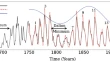
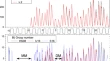
are shown in Figure 42
along with smoothed sunspot numbers. While the physical basis for
these predictions is appealing, the fact that the necessary measurements are only available
for the last three cycles is a distinct problem. It is unclear when the measurements should be
taken. Predictions by this group for previous cycles have given different values at different times.
The RMS differences between the published predictions and the observed cycle amplitudes
suggest that these predictions are about as good as the geomagnetic precursor predictions.
The polar fields are obviously much weaker during the current minimum. This has led to a
prediction of Rmax(24) = 75 ± 8 by Svalgaard et al. (2005
) – about half the size of the previous
three cycles based on the polar fields being about half as strong. While in previous minima
the strength of the polar fields (as represented by the average of the absolute field strength
in the north and in the south) varied as minimum approached, this did not happen on the
approach to cycle 24 minimum in late 2008. This suggests that the prediction made in 2005 still
holds.
Over the last decade dynamo models have started to include the effect of the Sun’s meridional circulation and found that it can play a significant role in the magnetic dynamo (cf. Dikpati and Charbonneau, 1999). In these models the speed of the meridional circulation sets the cycle period and influences both the strength of the polar fields and the amplitudes of following cycles. Two predictions have recently been made based on flux transport dynamos with assimilated data – with very different results.
Dikpati et al. (2006
) predicted an amplitude for cycle 24 of 150 – 180 using a flux transport dynamo
that included a rotation profile and a near surface meridional flow based on helioseismic observations. They
modeled the axisymmetric poloidal and toroidal magnetic field using a meridional flow that returns to the
equator at the base of the convection zone and used two source terms for the poloidal field – one at the
surface due to the Joy’s Law tilt of the emerging active regions and one in the tachocline due
to hydrodynamic and MHD instabilities. The diffusivity in the model is a function of depth
with a surface diffusivity of 5 × 1012 cm2 s–1 falling to 5 × 1010 cm2 s–1 at r = 0.9R⊙.
They drive the model with a surface source of poloidal field that depends upon the sunspot
areas observed since 1874. Measurements of the meridional flow speed prior to 1996 are highly
uncertain (cf. Hathaway, 1996) so they maintained a constant flow speed prior to 1996 and forced
each of those earlier cycles to have a constant period as a consequence. The surface poloidal
source term drifted linearly from 30° to 5° over each cycle with an amplitude that depended
on the observed sunspot areas. They based their prediction on the strength of the toroidal
field produced in the tachocline. They found excellent agreement between this toroidal field
strength and the amplitude of each of the last eight cycles (the four earlier cycles – during
the initialization phase – were also well fit but not with the degree of agreement of the later
cycles). The correlation they find between the predicted toroidal field and the cycle amplitudes is
similar to that found with the geomagnetic precursors and polar field strength indicators. When
they kept the meridional flow speed at the same constant level during cycle 23 they found
Rmax(24) ∼ 180. When they allowed the meridional flow speed to drop by 40% as was seen
from 1996 – 2002 they found Rmax(24) ∼ 150 and further predicted that cycle 24 would start
late.
Choudhuri et al. (2007
) predicted an amplitude for cycle 24 of 80 using a similar flux-transport dynamo
but with the surface poloidal field at minimum as the assimilated data. They used a similar axisymmetric
model for the poloidal and toroidal fields but with a meridional flow that extends below the base of the
convection zone and a diffusivity that remains high throughout the convection zone. In their model the
toroidal field in the tachocline produces flux eruptions when its strength exceeds a given limit. They
compare the number of eruptions to the observed sunspot numbers and use this as the predictor for
cycle 24. They assimilate data by instantaneously changing the poloidal field at minimum throughout most
of the convection zone to make it match the dipole moment obtained from the Wilcox Solar Observatory
observations (Figure 41
). They found an excellent fit to the last three cycles (the full extent of
the data) and found Rmax(24) ∼ 80, in agreement with the polar field prediction of Svalgaard
et al. (2005).
Criticism has been leveled against all of these dynamo-based predictions. Dikpati et al. (2006
) criticized
the use of polar field strengths to predict the sunspot cycle peak that follows by four years by questioning
how those fields could be carried down to the low latitude tachocline in such a short time. Cameron and
Schüssler (2007) produced a simplified 1D flux transport model and showed that with similar parameters
to those used by Dikpati et al. (2006
) the flux transport across the equator was an excellent
predictor for the amplitude of the next cycle but the predictive skill was lost when more realistic
parameterizations of the active region emergence were used. Yeates et al. (2008) compared an
advection-dominated model like that of Dikpati et al. (2006) to a diffusion-dominated models like that of
Choudhuri et al. (2007) and concluded that the diffusion-dominated model was better because
it gave a better fit to the relationship between meridional flow speed and cycle amplitude.
Dikpati et al. (2008a) returned with a study of the use of polar fields and cross equatorial flux as
predictors of cycle amplitudes and concluded that their tachocline toroidal flux was the best
indicator. Furthermore, they found that the polar fields followed the current cycle so that the
weak polar fields at this minimum are due to the weakened meridional flow. The strongest
criticism of these dynamo-based predictions was give by Tobias et al. (2006) and Bushby and
Tobias (2007). They conclude that the solar dynamo is deterministically chaotic and thus inherently
unpredictable.
| http://www.livingreviews.org/lrsp-2010-1 | This work is licensed under a Creative Commons License. Problems/comments to |