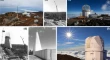
What is the next generation of synoptic observations? Through 40 years of effort, Olin Wilson, Sallie Baliunas, and their colleagues created one of the outstanding data sets of modern astrophysics, but despite this, our view on long-term stellar chromospheric variability has a number of critical limitations. For example, it is important to realize that Ca ii H & K is a completely negligible part of the spectrum. In his defense of the CO-mosphere, Ayres (2002) cautions us not to overlook “spectral backwaters” such as the far infrared. We would do well to note that the brackish water reaches our doorstep. Probably the critical region to sample from the ground in future synoptic studies is λλ 4000 – 5000, which includes in particular the CH G band near λ 4300, which precisely tracks magnetic flux concentrations directly related to the chromospheric and coronal activity of the star (Schüssler et al., 2003). The Lowell SSS is equipped with an echelle that samples ≈ λλ 5100 – 9000, primarily useful in surveying the chromospheric proxies in that part of the spectrum, but suffering, particularly redward of λ 6000, from numerous telluric blends. The solar cycle and even rotational signal is visible in the myriad “proxies” in the optical spectrum (Livingston et al., 2006; Livingston and Holweger, 1982; Hall and Lockwood, 1998), and these regions provide much more light than the dark heart of the Ca ii lines. This is particularly important if we extend our observations to fainter solar analogs (as with the Giampapa et al., 2006 Hydra observations of Ca ii, done with no small difficulty at mV ≈ 14, to study the distribution of activity in M67). Given the increasing realization of the importance of the evolution and distribution of the small-scale magnetic fields, the ideal next-generation synoptic instrument will ideally survey λλ 3900 – 6600.
What is the future of H & K? I should be as provocative as Wilson if I said it was time to send
Ca ii H & K to a home for retired proxies, but I do believe that if a research “cusp” such as we saw circa
1960, 1980, and 2000 is to occur in the future, it will not involve synoptic H & K observations.
There are still insights to be gleaned; the Lowell observations are satisfactorily stitched to the
MWO series and are now extending many of them, and we still have points to make about cycle
amplitude evolution and secular evolution of activity at cycle minima. However, the recent
spectroscopic-photometric retrospective published by Lockwood et al. (2007
) is largely incremental
over the previous reports from that program (Lockwood et al., 1997; Radick et al., 1998
);
and while the SSS HK database (Hall et al., 2007b) offers time series and some interesting
cycle detections beyond those of Baliunas et al. (1995), the overall behavior of the target set
yields few surprises. The essential astrophysical utility of long-term observations of activity
is the insights about the dynamo discussed in Section 4.3; further advances will come from
(1) broadening the set of synoptic ground-based proxies and (2) ensuring they are obtained
with contemporaneous photometry (cf. Radick et al., 1998
; Hall et al., 2007a
) and, if at all
possible, EUV and X-ray observations as Favata et al. (2004) and Hempelmann et al. (2006
) have
begun.
How special is the Sun? Although this is a commentary on stellar chromospheric activity, the field
has become so intertwined with solar work, and the evidence that stellar variations arise from structures
analogous to solar phenomena so overwhelming, that it is no longer possible to study magnetic phenomena
in either the Sun or its cousins in isolation. I have noted throughout that the recent detailed views of the
Sun are important guides for stellar work, assuming that the Sun is a typical G star. In a gross sense, it
appears to be, but if the devil is in the proverbial details, is it really? Solar twins have been hard to come
by, though the well-studied sample is severely magnitude-limited to perhaps mv = 7.5. The
“Top Ten” solar analogs of Soubiran and Triaud (2004) include the one star everyone seems
to agree on, 18 Scorpii = HD 146233 as #1; the rest are variously poorly studied, possibly
evolved (HD 95128), old (HD 186427), or binaries (HD 10307). Only very recently are other
genuine twins beginning to be found (Meléndez and Ramírez, 2007). One essential issue
here is the still puzzling photometric quiescence of the Sun relative to stars of similar color
(Lockwood et al., 2007; Radick et al., 1998). Interestingly, the photometric variability of the
one solar twin for which it has been measured, 18 Sco, is nearly identical to the Sun over a
full activity cycle (Hall et al., 2007a
) – and therefore also an outlier relative to most dwarfs
with B-V ≈ 0.65. So we can now pick our statistical poison: one star does not a trend make;
or, if the one star agreed to be a solar twin is also a photometric outlier, is there something
we don’t know about the Sun? Clearly, ongoing, synoptic observations of the slowly growing
sample of solar twins are critical, since it is otherwise difficult to approach this question without
treading uncomfortably close to the anthropic principle. Böhm-Vitense (2007), however, in
examining cycle lengths and rotation periods in the context of the “active” and “inactive” dynamo
branches of Saar and Brandenburg (1999), notes that the Sun lies squarely between the two
sequences and writes that “Clearly the Sun is not a good standard star for the discussion of
stellar activity. (Is its special position between the sequences necessary to permit life on earth to
evolve and survive?)”. I believe Wilson would have enjoyed pondering this question. (With
its shorter, ≈ 7.5-year cycle, 18 Sco lies somewhat off the I branch though not discordantly
so).
The next cusp. The arguments above show a profitable direction for future observations of stellar chromospheric activity most likely to lead to fundamental advances. The Sun is the one star for which we have an outstanding view to a chromosphere, and an increasingly detailed understanding of its fine structure. We also know the Sun spends some amount of its time in grand minima whose occurrence has been very recently argued to be chaotic (Usoskin et al., 2007). Wilson selected the MWO stars to sample a broad ensemble; we now need to contract the color-magnitude box around the Sun, push to fainter magnitudes (to at least mV = 10) to find other solar twins and analogs, and increase the time resolution of observations of stellar analogs of the modern and Maunder Minimum Sun. Essential complements will be contemporaneous high-precision photometry as Hall et al. (2007a) have done for 18 Sco, and at least a few EUV and X-ray observations per year as Hempelmann et al. (2006) are doing for 61 Cygni. Such work opens a host of questions: Is the Sun special? If so, how big is the parameter space that delineates a truly “Sun-like” dynamo and resulting activity? Are the Sun’s grand minima similar to those of τ Ceti?
This is a modification of the question posed by Wilson three decades ago: Does the chromospheric activity of other Suns vary, and if so, how similarly to the Sun’s? Hopefully, at some point, this Living Review can be updated with at least a partial answer.
| http://www.livingreviews.org/lrsp-2008-2 | This work is licensed under a Creative Commons Attribution-Noncommercial-No Derivative Works 2.0 Germany License. Problems/comments to |