| Figure 1:
Three temperature maps of young, active solar analogs, derived from Doppler imaging. From left to right: HD 171488 (P = 1.34 d; Strassmeier et al. 2003), HII 314 (P = 1.47 d; Rice and Strassmeier 2001), and EK Dra (P = 2.7 d; Strassmeier and Rice 1998) (see also |
|
![]() |
Figure 2:
Zeeman–Doppler images of the rapidly rotating early G dwarf HD 171488, showing, in polar projection, spot occupancy (upper left), the radial magnetic field (upper right), the azimuthal magnetic field (lower left – note the ring-like high-latitude feature), and the meridional magnetic field (lower right) (from Marsden et al. 2006, reprinted with permission of Blackwell Publishing). |
| Figure 3:
Simulations of surface magnetic fields for a star like the Sun (left) and an active star with a bipole emergence rate 30 times higher (right). Various snapshots during the activity cycle are shown (from top to bottom). Note the concentration of magnetic flux in rings of opposite polarity around the pole of the active star (from Schrijver and Title, 2001, reproduced by permission of AAS). |
|
| Figure 4:
Two examples of X-ray rotational modulation in young, active solar analogs: Left (a): EK Dra (Güdel et al., 1995c); right (b): the supersaturated young solar analog VXR45 (Marino et al., 2003a). Both light curves are phase-folded (reprinted with permission). |
|
| Figure 5:
Light curve and image reconstruction of the A+G binary |
|
![]() |
Figure 6:
Magnetic-field geometry of a corona of a solar analog. From left to right: present solar activity, 10fold higher activity, 30fold higher activity. The panels from top to bottom show configurations at different phases of the activity cycle (0.00 = minimum, 0.16, 0.33, 0.49 |
| Figure 7:
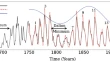
Left (a): Ratio between activity-cycle frequency and rotation frequency plotted vs. the inverse Rossby number, mostly for solar analogs. Three theoretical branches (“inactive”, “active”, and “super-active”) are shown by solid lines. Key to the labels: A = BE Cet, B = |
|
| Figure 8:
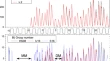
V band photometric time series and sinusoidal (plus long-term trend) fits for EK Dra (left, a) and |
|
| Figure 9:
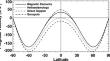
Left (a): Rotation period variation as a function of the mean rotation period, for a sample of young solar analogs. The solid line is a power-law fit to the entire sample also containing early K stars, while the dotted line is a fit to the G-star sample only. Key to the labels: A = BE Cet, B = |
|
| Figure 10:
Left (a): Mass-loss rates per unit surface area vs. stellar X-ray surface fluxes. MS stars are shown by filled circles. The trend for inactive stars (shaded area) is not followed by more active stars. – Right (b): Inferred mass-loss history of the Sun. Again, the trend shown for inactive stars (shaded area) breaks down for the most active stars (from Wood et al., 2005, reprinted with permission of AAS). |
|
![]() |
Figure 11:
Relation between rotational velocity, v, and age for solar analogs. The diamond-shaped areas show the large scatter of v in young clusters, before rotational convergence has been attained (from Ayres, 1997, reprinted with permission). |
![]() |
Figure 12:
Extracts of UV spectra of solar analogs with different ages. All spectral fluxes have been transformed to irradiances at 1 AU from the star. The spectra have been shifted along the ordinate, by multiples of 0.2 erg s–1 cm–2 Å–1 (from Ribas et al., 2005, reproduced by permission of AAS). |
![]() |
Figure 13:
Extracts of FUV spectra of solar analogs with different ages. The region of the O vi doublet is shown. All spectral fluxes have been transformed to irradiances at 1 AU from the star. The spectra have been shifted along the ordinate, by multiples of 1 erg s–1 cm–2 Å–1 (from Ribas et al., 2005, reproduced by permission of AAS). |
![]() |
Figure 14:
Left: X-ray luminosity of solar analogs (from the “Sun in Time” sample), and power-law fit (slope = –2.6). The three objects marked with open squares are close binaries consisting of two early-G solar analogs that rotate synchronously with their orbit motion. These latter stars are in the saturation regime (“RS” and “MEKAL” refer to two different atomic line codes used for the spectral interpretation; from Güdel et al. 1997b, reproduced by permission of AAS). Right: Normalized X-ray and C iv luminosities as a function of rotational velocity for solar analogs. Luminosities of the fastest rotators do not follow the regression laws because of saturation (from Ayres, 1997, reprinted with permission). |
![]() |
Figure 15:
Extracts of the EUV spectra of solar analogs with different ages. All spectral fluxes have been transformed to irradiances at 1 AU from the star. The spectra have been shifted along the ordinate, by multiples of 10 erg cm–2 s–1 Å–1 (from Ribas et al., 2005, reproduced by permission of AAS). |
![]() |
Figure 16:
Fluxed high-resolution X-ray spectra of solar analogs with different ages, obtained with the RGS instruments on board XMM-Newton. The topmost two spectra are from K-type T Tauri stars (BP Tau is a classical T Tauri star, V410 Tau a weak-line T Tauri star), while the other spectra are from MS solar analogs. Fluxes are given at a distance of 1 AU from the star, in erg cm–2 s–1 per bin, where the bin width is given in parentheses after the star’s name in each panel (usually 0.05 Å except for |
![]() |
Figure 17:
Low-resolution CCD X-ray spectra of solar analogs with different ages, obtained with the EPIC MOS instrument on board XMM-Newton. The topmost two spectra are from K-type T Tauri stars (BP Tau is a CTTS, V410 Tau a WTTS), while the other spectra are from MS solar analogs. The sequence of the spectra from top to bottom is reflected in the lower left panel, and also by the colors of the spectra used for the stellar names. Count rate spectra have been normalized to the distance of 47 Cas (33.56 pc); the spectrum of BP Tau has been shifted upward by an additional factor of 30 for clarity (adapted from Telleschi et al. 2005 and Telleschi et al. 2007b). |
![]() |
Figure 18:
Mean coronal temperature of solar analogs as a function of the X-ray luminosity. The dashed and solid lines are the regression fits to results based on different atomic data. The triangles mark the range of the solar corona between activity minimum and maximum (figure from Telleschi et al., 2005, reproduced by permission of AAS). |
| Figure 19:
Left (a): Power-law decays in time for various spectral ranges, normalized to the present-day solar flux. Note that the hardest emission decays fastest (from Ribas et al., 2005, reproduced by permission of AAS). Right (b): Flux decay slope (given as its absolute value) as a function of formation temperature of the respective line; each cross marks one emission line reported in Table 5. |
|
![]() |
Figure 20:
Top: Spectral irradiance of EK Dra for a distance of 1 AU. The various instruments used for the reconstruction are marked. Bottom: Irradiances at 1 AU from solar analogs with different ages (from Guinan and Ribas, 2002, reprinted with permission of ASP). |
![]() |
Figure 21:
UV irradiances of EK Dra (upper spectrum) and the very old solar analog, |
![]() |
Figure 22:
Correlation between normalized coronal X-ray and transition-region (C iv) UV emission for solar-like field and cluster stars (from the ROSAT/IUE All Sky Survey [RIASS], see Ayres 1997, reprinted with permission). |
![]() |
Figure 23:
Relation between LR/Lbol and the stellar rotation period. Note upper limits for slow rotators. The dotted line illustrates the slope of the X-ray decay law as a function of P (Equation 13 |
![]() |
Figure 24:
Relation between non-thermal radio emission and average coronal temperature (from Telleschi et al., 2005, reproduced by permission of AAS). Open and filled circles refer to different atomic emission line codes used for the temperature determination. |
![]() |
Figure 25:
X-ray light curve of the young (ZAMS) solar analog EK Dra, obtained with XMM-Newton. The curves refer to the total 0.2–10 keV photon energy range (black), the soft band (0.2–1 keV; green), the hard band ( |
![]() |
Figure 26:
Cumulative flare rate distributions in energy for 47 Cas, EK Dra, and both combined. The indices of power-law fits to the cumulative distributions are smaller than those of the differential distributions by one, |
![]() |
Figure 27:
Coronal element abundances normalized to the Fe abundance, with respect to the solar photospheric mixture as a function of FIP; the total X-ray luminosities are, from top to bottom: log LX = 30.06 (BP Tau), 30.66 (V410 Tau), 30.39 (47 Cas B), 30.08 (EK Dra), 29.06 ( |
| Figure 28:
Coronal abundances of Fe (low FIP) and Ne (high FIP – left plot), and ratios of Mg/Fe (low FIP) and O/Ne (high FIP – right plot) for various stars, shown as a function of the average coronal temperature (from Güdel, 2004, © Springer Verlag, reprinted with permission). |
|
![]() |
Figure 29:
Sketch of the environment of a classical T Tauri star or a protostar, showing the star, the circumstellar disk, magnetic field lines, and closed star-disk magnetic field structures that funnel material from the disk to the star (adapted from Camenzind, 1990, © Wiley-VCH Verlag, reproduced with permission). |
![]() |
Figure 30:
Summary of properties of PMS objects, in comparison with MS stars (from Feigelson and Montmerle, 1999, © 1999 by Annual Reviews, reprinted with permission). |
![]() |
Figure 31:
Evolution of the X-ray luminosity of a near-solar mass star. A sample of field stars from the “Sun in Time” program is shown by filled circles. Open circles show the median LX for G-type stars in open clusters for ages |
| Figure 32:
Left (a): The ultraviolet excess of CTTS. The figure shows the mean continuum surface flux at |
|
![]() |
Figure 33:
Comparison of fluxed X-ray photon spectra of (from top to bottom, all from XMM-Newton RGS) the active binary HR 1099, the WTTS V410 Tau, the CTTS T Tau, the T Tau spectrum modeled after removal of absorption (two versions, using NH = 3 |
![]() |
Figure 34:
The coronal Fe/Ne abundance ratio (with respect to the solar photospheric mixture) in the X-ray sources of various PMS stars and very active MS stars as a function of spectral class. Symbols mark different types of stars: squares: active MS stars; triangles: WTTS; diamonds: CTTS. For details and references, see Telleschi et al. (2007b) and Güdel et al. (2007b). |
![]() |
Figure 35:
Consequences of X-ray irradiation of a circumstellar disk, shown in the r vs. |
![]() |
Figure 36:
Gas and dust temperatures of a circumstellar disk as a function of vertical column density. Different solid lines give the gas temperature for various viscous-heating rates. The leftmost curve is predominantly due to X-ray heating, in the rightmost curve, viscous heating is important. The dashed line gives the dust temperature from a standard dust-disk model (figure from Glassgold et al., 2004, reproduced by permission of AAS). |
![]() |
Figure 37:
Illustration of the greenhouse and the Faint Young Sun Paradox for the Earth. The solid line indicates the solar luminosity relative to the present value (right y axis); the lower dashed curve is the effective radiating temperature of the Earth (i.e., its surface being treated as a blackbody radiator); the upper dashed curve shows the calculated, mean global surface temperature affected by the greenhouse (CO2 mixing ratio and relative humidity have been kept fixed; from Kasting and Catling 2003, © 2003 by Annual Reviews, reprinted with permission). |
![]() |
Figure 38:
Solar flux in time relative to present, for a Sun that was subject to strong mass loss in its past. Different curves show calculations for different initial masses and corresponding mass-loss rates such that the present-day values are obtained. The mass-loss rate declines exponentially in time; the flux increase at later times is due to the luminosity increase of the Sun for nearly constant mass. The double arrow indicates the lower limit for the presence of liquid water on early Mars, the thin arrow an (unrealistic) extreme lower limit (from Sackmann and Boothroyd, 2003, reproduced by permission of AAS). |
![]() |
Figure 39:
Evolution of the constituents of the Earth’s atmosphere in time (adapted from |
![]() |
Figure 40:
Photoionization rates for H, O, O2, and N2 for different ages of the Sun, derived from the level of ionizing flux of solar analogs. The thick solid lines give the best estimates, the shaded areas give the allowed ranges based on uncertainties in the rotation-activity relationship (from Ayres, 1997, reprinted with permission). |
![]() |
Figure 41:
Modeled temperature profiles for Venus for various solar XUV levels: 1 = present-day, 10 times (3.8 Gyr ago), 50 times (4.33 Gyr ago), and 100 times (4.5 Gyr ago) present levels, based on a 96% CO2 thermosphere (from Kulikov et al., 2007, © Springer Verlag, reprinted with permission.). |
![]() |
Figure 42:
Modeled temperature profiles for Mars for various solar XUV levels: 1 = present-day, 10 times (3.8 Gyr ago), 50 times (4.33 Gyr ago), and 100 times (4.5 Gyr ago) present levels, based on a 96% CO2 thermosphere (from Kulikov et al., 2007, © Springer Verlag, reprinted with permission). |
![]() |
Figure 43:
Comparison of evolutionary paths of Venus, Earth, and Mars, accounting for the influence of solar XUV and particle radiation (from Kulikov et al., 2007, © Springer Verlag, reprinted with permission). |
![]() |
Figure 44:
Temperature profile through the atmosphere of the “hot Jupiter” HD 209458b in a 0.046 AU orbit around its solar-analog host star, for different XUV radiation levels corresponding to ages of 4, 2, 1, 0.5, 0.2, and 0.1 Gyr (from Penz et al., 2007, reprinted with permission). |
| http://www.livingreviews.org/lrsp-2007-3 | This work is licensed under a Creative Commons Attribution-Noncommercial-No Derivative Works 2.0 Germany License. Problems/comments to |