Messina and Guinan (2002
) specifically studied starspot cycles of stars from the “Sun in Time” program.
Activity cycles are found in all of them, with periods ranging from 2.1 yr to 13.1 yr. A comparison with the
more comprehensive survey and the theoretical interpretations presented by Saar and Brandenburg (1999)
confirms the presence of two or three branches: i) inactive solar analogs show cycles about 100 times longer
than the rotation period, P ; ii) active stars reveal cycles 200–600 times longer than P ; iii)
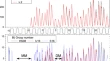
and “super-active” stars show cycles about 4 order of magnitude longer than P (Figure 7
a).
Among G-type stars, only EK Dra appears to be compatible with the third class (Messina and
Guinan 2002
).
|
The brightness amplitude increases with increasing inverse Rossby number (i.e., increasing rotation
rate for constant turnover time), indicating that spots produce progressively more modulation
toward higher activity levels (Figure 7
b). A plateau is suggested for the most active stars,
indicating a saturation effect when spots cover a large fraction of the stellar surface (Messina and
Guinan, 2002
).
|
The standard near-ZAMS solar analog, EK Dra, has been an important target for cycle studies. Dorren
and Guinan (1994a
) and Dorren and Guinan (1994b) showed that its long-term photometric variations by
0.07 mag are consistent with a period of about 12 yr. Variations compatible with this time scale are
also found in Ca ii HK, Mg ii h and k, and the ultraviolet C iv, C ii, and He ii fluxes (Dorren and
Guinan, 1994a
), and in X-rays (see Section 4.3.2 below). The spot periodicity has been confirmed by
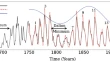
Messina and Guinan (2002) although their best estimate for the period is 9.2
0.4 yr (Figure 8
). The
star is optically faintest when chromospheric and transition-region activity is highest. On top of this cyclic
behavior, there is a long-term trend in the optical light, namely a decline of the blue light by
0.0017
0.0004 mag yr–1 for an investigated time span of 35 yr (Fröhlich et al. 2002; see also
Messina and Guinan 2003
and Järvinen et al. 2005
). Further, two active longitudes shift in phase in
concert with the activity cycles (Järvinen et al., 2005). The dominant spot concentration switches
between the two preferred longitudes with a “flip-flop” cycle of about 4–4.5 yr. These features
suggest the coexistence of axisymmetric and non-axisymmetric dynamo modes (Berdyugina
et al., 2002).
Messina and Guinan (2003
) have studied photometric periods from spot modulations, arguing that – as
in the solar case – the varying dominant latitudes of the spots should induce a periodic variation of the
rotation period in phase with the activity cycle, because of differential rotation. These correlated period
variations are indeed present in solar analogs (Messina and Guinan, 2003
), although two patterns are seen:
either, the period decreases as the cycle proceeds (solar behavior), or it increases (anti-solar behavior). The
former effect is due to spot migration toward the equator where the surface rotation is faster. The second
effect could be due to pole-ward acceleration of rotation at higher latitudes where active stars
predominantly show spots, while the individual spots may still migrate toward the equator. Messina and
Guinan (2003
), however, suggest that high-latitude spots migrate toward the (slower-rotating) pole, which
induces an anti-solar behavior in particular for stars with small inclination angles. This model is
preferred because correlations involving the fractional variation in the rotation period show
the same behavior for the two subclasses. Support for the model comes from simulations of
magnetic-field migration toward the poles in very active stars, as performed by Schrijver and
Title (2001) (Section 4.1.2). Specifically, Messina and Guinan (2003
) have found a power-law relation
between the rotation-period variation,
P, and the average rotation period, P , of the form (see
Figure 9
a)
Further, a tight correlation is found between differential rotation, parameterized by
, and the
activity cycle frequency,
,
suggesting that
is a key parameter controlling the duration of the activity cycle (see
Figure 9
b).
Differential rotation has also been measured on other very active stars (e.g., Donati et al. 2003a
),
among them a solar-like post-T Tauri star (Donati et al., 2000
), in particular based on Doppler imaging
techniques (Section 4.1.1). Differential rotation was found to be solar-like in these examples, although
time-variable, which may hint at dynamo processes that periodically convert magnetic into kinetic energy
and vice versa (Donati et al., 2003a).
|
Given the much stronger variability in the outer, coronal layers of a stellar atmosphere, an activity cycle may be more easily identified in the X-ray or radio domains. However, such cycles have eluded detection until recently because no appropriate program had been carried out for sufficiently long periods. A few notable examples have now been reported from X-ray monitoring.
First tentative evidence for an X-ray cycle came from the young solar analog EK Dra that was
monitored between 1990 and 2000 using ROSAT, ASCA, and XMM-Newton. Initial results were presented
in Dorren et al. (1995
), a more complete time series has been published by Güdel (2004
). There is a
suggestive anti-correlation between X-ray flux and photospheric brightness (the star is optically brightest at
its activity minimum), although the total X-ray luminosity varies by no more than a factor of
2–3.
Other reports refer to inactive solar analogs and K-type stars. Hempelmann et al. (2003) and Hempelmann et al. (2006) have reported a correlation between X-ray luminosity and the Ca H & K S index for the two K-type stars 61 Cyg A and B. Both show chromospheric modulations on time scales of about 10 years, one being regular and the other irregular. A gradual X-ray modulation was also seen during a time span 2.5 years in the G2 V star HD 81809, although there seems to be a phase shift by about 1 year with respect to the Ca cycle (Favata et al., 2004).
Additional information on potential coronal activity cycles has been collected from multiple observations
of young open clusters and star-forming regions. Generally, such samples indicate that magnetically active,
solar-like stars mostly lack well-expressed X-ray cycles unless their cycle-induced variability is
no more than a factor of
2 (Gagné and Caillault, 1994; Gagne et al., 1995a
,b; Stern
et al., 1994, 1995
; Micela et al., 1996; Sciortino et al., 1998; Grosso et al., 2000; Marino
et al., 2002, 2003b).
| http://www.livingreviews.org/lrsp-2007-3 | This work is licensed under a Creative Commons Attribution-Noncommercial-No Derivative Works 2.0 Germany License. Problems/comments to |