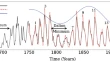
The most advanced (indirect) imaging technique to map magnetic structure in stellar photospheres is Doppler imaging that uses deformations in spectral-line profiles to map starspots (Vogt and Penrod, 1983).
Surface imaging using Doppler reconstruction methods or spot modeling has been performed for several
young, active solar analogs. Figure 1
shows views of the three examples discussed below. The colors code
for temperature (from
http://www.aip.de/groups/activity/DI/maps/).
|
The photosphere of EK Dra has been extensively mapped using spot modeling (Järvinen et al., 2005
)
and Doppler imaging techniques (Strassmeier and Rice, 1998
). Doppler images show spots both close to the
visible pole but also near the equator, the dominant feature being located at latitudes of 70–80 deg
(Strassmeier and Rice, 1998). This is supported by radial-velocity variations (König et al., 2005). The
polar region of EK Dra is, however, less pronounced than in more active (binary) stars, perhaps indicating
a trend toward lower-latitude spots for less active stars, as predicted by the Schüssler et al. (1996
) theory
of Coriolis-force driven magnetic flux tubes that converge to the pole for very rapid rotators (see
below).
The Pleiades G dwarf HII 314 (P = 1.47 d) has been Doppler-imaged by Rice and Strassmeier (2001
).
Again, high-latitude and polar spots are visible. The still younger, “infant Sun” HD 171488 = V889 Her
(P = 1.34 d, age = 30 Myr), a star in its last stage of evolution toward the ZAMS, shows
very prominent polar spots and various high-latitude dark features (Strassmeier et al., 2003
).
Further Doppler maps have been presented for the early G-type ultra-fast rotators He 520 (P
= 0.49 d) and He 699 (P = 0.61 d). Again, apart from the prominent polar spots, there
is a definitive band of low-latitude (l
30–40 deg) spots on these stars as well (Barnes
et al., 1998).
Although these surface spot distributions vary significantly between young solar analogs, there is agreement with regard to high-latitude magnetic activity on all of them (Rice and Strassmeier, 2001; Strassmeier et al., 2003).
The most recent Doppler technique uses spectropolarimetric observations of lines to apply
Zeeman–Doppler Imaging (ZDI), which results in maps of radial, azimuthal, and meridional magnetic fields.
Successful application to solar analog stars have been presented by Marsden et al. (2006
) and Catala
et al. (2007
); excellent ZDI maps have also been derived for the somewhat cooler, young early-K star
AB Dor (Donati et al., 2003b
), and put into context with coronal X-rays (Jardine et al., 2002c; McIvor
et al., 2003
; Hussain et al., 2007
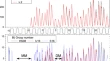
). ZDI images (Figure 2
) have shown non-solar magnetic features such as
high-latitude “rings” of azimuthal (toroidal) field (Donati et al., 2003b; Marsden et al., 2006
; Catala
et al., 2007), possibly suggesting that the responsible magnetic dynamo is located close to the
surface (a “distributed dynamo”) rather than (only) near the tachocline where azimuthal fields
are expected for
-type dynamos. The field distribution and orientation also serves as an
important diagnostic to study and explain spot lifetimes based on numerical studies (Işık
et al., 2007).
|
Why are there polar spots in magnetically active stars? Schüssler and Solanki (1992) and Schüssler
et al. (1996
) suggested that strong Coriolis forces act on magnetic flux bundles that rise from the dynamo
region at the boundary between the radiative core and the convective envelope of the star. This force
would deflect rising flux to higher altitudes although, given the size of the radiative core, the
maximum latitude would probably be no more than about 60 degrees. A parameter study confirms
these findings systematically, with flux emergence latitudes increasing with i) rotation rate, ii)
decreasing stellar mass (i.e., smaller radiative core radii), and iii) decreasing age; a fraction of
the flux tubes will, however, also erupt in near-equatorial regions (Granzer et al., 2000). To
produce truly polar spot regions, additional latitudinal transport of flux tubes is still required.
A possibility is an additional pole-ward slip of a segment of a flux ring in the stellar interior
after the eruption of flux at mid-latitudes in another segment of the same ring (Schüssler
et al., 1996
).
Alternatively, Schrijver and Title (2001
) explored migration of surface magnetic fields toward the poles
in a model developed by Schrijver (2001
). Here, magnetic bipoles are injected randomly. These flux
concentrations migrate pole-ward in a meridional flow and are subject to differential rotation. The bipoles
can interact, i.e., fragment, merge, or cancel. The magnetic cycle is simulated by periodically varying the
injection latitudes. Schrijver and Title (2001
) simulated a star with a bipole injection rate 30 times higher
than the present-day Sun, corresponding to a solar analog with a rotation period of 6 d, i.e., an age of a
few 100 Myr. The differential rotation profile was assumed to be identical to the present-day
Sun’s, and so was the length of the activity cycle (11 yr). In the present-day Sun, the pole-ward
migration of the trailing flux in a bipole cancels with existing high-latitude flux of opposite polarity
relatively rapidly. In the simulations of the active star, however, the magnetic concentrations
contain more flux, resulting in slower diffusion and a longer lifetime before cancellation. The
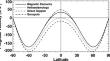
result of these simulations is that, first, there are strong magnetic features accumulating in the
polar regions, and second, nested magnetic rings of opposite polarity form around the pole
(Figure 3
). These are suggestive sites of chromospheric and coronal interactions, perhaps leading to
strong coronal heating and flares in these polar regions. As described above, ZDI images indeed
provide evidence for high-latitude “rings” of azimuthal (toroidal) field (e.g., Marsden et al. 2006,
Figure 2
).
Observationally, the picture is more complicated. In contrast to these simulations and also
in contrast to the solar picture, Doppler images of very active, young stars (Figure 1
) show
intermingling of opposite polarities in longitude also at high latitudes (Mackay et al., 2004
).
Such features can indeed be reproduced if the latitudes of flux emergence are shifted poleward,
to 50–70 degrees, and the meridional flow be made faster (Mackay et al., 2004; Holzwarth
et al., 2006). The first modification is of course suggested from the Schüssler et al. (1996)
theory.
The structure of polar spots (unipolar, multiple bi-polar regions, or nested rings of different polarity) is indeed also very important for the large-scale coronal field; unipolar magnetic spots suggest the presence of more polar open-field lines, therefore concentrating strong coronal X-ray emission to more equatorial regions, but also reducing the efficiency of angular momentum removal by the magnetized wind due to the smaller lever arm compared to equatorial winds (McIvor et al., 2003).
|
| http://www.livingreviews.org/lrsp-2007-3 | This work is licensed under a Creative Commons Attribution-Noncommercial-No Derivative Works 2.0 Germany License. Problems/comments to |