Magnetic flares in the solar and stellar atmospheres heat plasma explosively to
10 MK on time scales
of minutes. Large amounts of emission measure are produced, presumably by bringing up heated material
from the chromospheric layers, thus increasing the density in coronal regions of magnetic loops. It has been
suggested that much, if not all, of the hot coronal plasma has been heated (and evaporated) by flares that
may be too small and too frequent to be detected individually. This hypothesis is known as the
“microflare” or “nanoflare” hypothesis in solar physics (Parker, 1988). There is observational
evidence that numerous small-scale flare events occur in the solar corona at any time (e.g., Lin
et al., 1984). Hard-X-ray studies have shown that they are distributed in energy according to a power
law,
where dN is the number of flares per unit time with a total energy in the interval [E,E+dE], and k is a
constant. If
, then the energy integration (for a given time interval,
E[dN/dE]dE) diverges
for Emin
0, that is, if the power law is extrapolated to small flare energies, a lower cut-off is required
for the power-law distribution; arbitrary energy release powers are possible depending on the value of Emin.
From solar studies,
1.6–1.8 for ordinary solar flares (Crosby et al., 1993), but some
recent studies of low-level flaring suggest
= 2.0–2.6 (Krucker and Benz, 1998; Parnell and
Jupp, 2000).
There is abundant evidence that flare-like processes are important in magnetically active stars:
|
Motivated by the above phenomenology, several studies have addressed flare distributions in stellar coronae.
Earlier work by Collura et al. (1988) and Pallavicini et al. (1990) indicated power laws with
2
although the sensitivities used in those observations were quite limited, and flares from different stars at
different distances were lumped together. This also holds for a study by Osten and Brown (1999) for
RS CVn-type binaries.
To avoid bias with regard to detection limits at lower energies, new methods have been devised by
Audard et al. (1999
), Audard et al. (2000
), Kashyap et al. (2002), Güdel et al. (2003b
), and Arzner and
Güdel (2004), the latter three using Monte Carlo forward methods and analytical inversion. Work by Wolk
et al. (2005
), Arzner et al. (2007), and Stelzer et al. (2007
) has extended flare statistics into the PMS
domain.
Most of these recent studies converge to
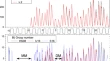
2.0–2.5 (Figure 26
), indicating a potentially crucial role
of flares in coronal heating if the power-law flare energy distribution extends by about 1–2 orders of
magnitude below the actual detection limit in the light curves. The X-ray coronae of active
stars would be an entirely hydrodynamic phenomenon rather than an ensemble of hydrostatic
loops.
|
This mechanism has been studied specifically for young solar analogs by Güdel et al. (1997b
),
Güdel (1997
), Audard et al. (1999
), and Telleschi et al. (2005
), in particular with regard to synthetic
light curves and emission measure distributions.
Güdel et al. (1997b) found that the time-averaged emission measure distribution of solar flares adds a
characteristic, separate emission measure component at high temperatures (
10 MK); numerical
simulations support this picture (Güdel, 1997), and corresponding hot emission measure components are
indeed also identified in active solar analogs from X-ray spectroscopic observations. If a full distribution of
flares contributes, including small flares with lower temperature, then the entire observed X-ray emission
measure could be formed by the continually heating and cooling plasma in flares. The predicted steep low-T
slope (up to
4) of an emission measure distribution induced by stochastic flaring compares very
favorably with observations of active stars (Güdel et al., 2003b). This holds true specifically for
solar analogs for which
= 2.2–2.8 is implied from the emission measure slopes (Telleschi
et al., 2005
).
Audard et al. (1999) and Audard et al. (2000
) derived the flare energy distribution of young solar
analogs (Figure 26
, where the cumulative distributions are plotted, with a power-law index that is shallower
by one unit) and studied consequences for the thermal structure of the active coronae. They
speculated that the higher temperatures in active coronae are due to a larger rate of (larger)
flares, although they left undecidedwhether there is a larger rate of reheating events of the
same coronal structures or whether a higher number of active regions produce the higher flare
rate.
The above overview suggests that the young solar corona may have been strongly driven by flares erupting as a consequence of magnetic instabilities. There is no conclusive proof that stochastic flares dominate coronal heating although there is clear evidence that active stellar coronae are continuously variable on time scales similar to flare events, and there is ample circumstantial albeit indirect evidence supporting this model, as described above. There are important implications from flare-heating coronal models:
| http://www.livingreviews.org/lrsp-2007-3 | This work is licensed under a Creative Commons Attribution-Noncommercial-No Derivative Works 2.0 Germany License. Problems/comments to |