Ionisation of molecules in the lower atmosphere is brought about by cosmic rays and by
naturally-occurring radioactivity. The latter consists of airborne alpha-particle emitters (such as radon gas)
and direct gamma radiation from the soil. Cosmic radiation consists of extremely high energy (
GeV)
particles, mostly protons and helium nuclei. Both sources cause an electron to separate from a molecule of
nitrogen or oxygen; the electron then being captured by a neutral molecule on a very short
timescale. Thus equal numbers of positive and negative ions are produced. Other processes can
introduce a net charge into the atmosphere; these include combustion, rainfall and breaking ocean
waves.
Cosmic rays are responsible for approximately 20% of the ionisation over land surfaces and provide the
principle source of ionisation over the oceans. The ionisation rate increases with altitude reaching a peak
near 15 km (see Figure 46
a). The geographical distribution of cosmic ray ionisation is strongly modulated
by geomagnetism with the rays tending to follow the magnetic field lines down to the magnetic poles. Thus
only very high energy cosmic radiation reaches the Earth’s surface in low latitudes while much lower energy
rays penetrate at high latitudes.
Solar activity modulates the heliospheric magnetic field which acts as a shield to cosmic rays. Thus,
during periods of higher solar activity fewer cosmic rays reach the Earth, although the modulation primarily
affects lower energy cosmic radiation. At the Earth’s surface cosmic rays are monitored by neutron monitors
which detect the disintegrated particles (e.g. pions, muons) produced when cosmic radiation
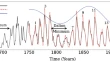
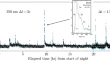
impacts atmospheric particles. Figure 46
b presents a time series of the neutron count rate at two
surface stations. The lower latitude station clearly shows lower counts and a weaker solar cycle
modulation.
|
The mechanism proposed by Dickinson (1975), and adopted by Marsh and Svensmark (2000) to
account for the correlation of tropical marine low cloud cover and cosmic radiation in Figure 10
, requires
that modulation by solar variability of cosmic rays causes a response in the concentration of cloud
condensation nuclei. Several consecutive processes (summarised in Figure 47
) need to take place in order for
this to come about. Firstly air ions are produced by the action of cosmic rays; this is not controversial, as
discussed above, but it should be noted that these ions cannot act directly as cloud condensation nuclei as
their small size would require the surrounding air to have a very high level of supersaturation which does
not occur in the atmosphere.
|
The air ions produced by the cosmic rays may act as sites for the nucleation of new ultrafine aerosol (or
condensation nuclei, CN). The mechanism then hinges on the extent to which these CN may grow into
particles large enough (
80 nm) to become cloud condensation nuclei (CCN) and whether this process is
enhanced by the particles being charged. Growth may occur through condensation of water vapour or other
soluble gases or through coagulation among neutral and charged particles. Some observational
evidence (Yu and Turco, 2000) suggests that charged molecular clusters grow faster than neutral
clusters and chemical box models (Yu and Turco, 2001) have been able to simulate this effect.
However, to reach CCN size would take several days and whether the growth can be maintained
depends on the supply of vapour and competitive sources of new aerosol and CCN all of which
vary with location, altitude and time of year. Yu (2002) suggests that conditions in the lower
troposphere may be more favourable than at higher altitudes but Arnold (2006) concludes that such
processes are most likely to occur in the upper troposphere, providing there is a sufficient supply of
SO2.
Even if by such a mechanism it proves feasible to produce a measurable effect on cloud cover or properties, the magnitude, and even the sign, of the impact on radiative forcing remains uncertain as it will depend on the cloud location, altitude and physical properties.
| http://www.livingreviews.org/lrsp-2007-2 | This work is licensed under a Creative Commons Attribution-Noncommercial-No Derivative Works 2.0 Germany License. Problems/comments to |