5.5 Impact of the stratosphere on solar radiative forcing of climate
In Section 3.2 it was noted that the most accurate estimates of climate radiative forcing are those which
take into account the effect of changes in the stratosphere on the radiative flux at the tropopause. Thus a
better estimate of radiative forcing to solar irradiance changes should incorporate the effects
of the influence of variations in UV on stratospheric temperature and composition (as first
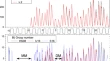
noted by Haigh, 1994). Figure 31 (above) shows solar irradiance at winter mid-latitudes as
a function of wavelength and altitude calculated using a 2D atmospheric model with fairly
complete representations of photochemical and radiative processes. At the top of the atmosphere
most energy is at visible wavelengths and this is transmitted almost unaffected through to the
surface. At wavelengths shorter than about 300 nm, however, most radiation is bsorbed by the
time it reaches an altitude of around 40 km. There is also some absorption at longer visible
wavelengths.
| Table 3: |
A summary of published estimates of solar radiative forcing. 1st column: reference; 2nd:
nominal solar variability; 3rd and 4th: solar UV radiative forcing at the top of atmosphere and at the
tropopause; 5th solar-induced ozone change; 6th, 7th and 8th: impact of ozone change on shortwave
and longwave components of radiative forcing and the net effect; 9th: percentage amplification of solar
forcing due to change in ozone. |
|
|
|
|
|
|
|
|
|
|
Author
|
Solar
change
|
S
RF
(toa)
|
S
RF
(tpse)
|
O3
|
O3
SW
effect
|
O3
LW
effect
|
Net
O3
effect
|
Amplification
(%)
|
|
|
|
|
|
|
|
|
|
|
Haigh (1994)
|
11-year
amp
|
0.13
|
0.11
|
+ve
peak
near
40 km
|
–0.03
|
+0.02
|
–0.01
|
–9
|
|
|
|
|
|
|
|
|
|
|
Hansen
et al. (1997)
|
11-year
amp
|
0.13
|
0.11
|
+ve
10 – 150 hPa
|
|
|
+0.05
|
+45
|
|
|
|
|
|
|
|
|
|
|
Myhre
et al. (1998)
|
11-year
amp
|
0.13
|
0.11
|
+ve
|
–0.08
|
+0.06
|
–0.02
|
–18
|
|
|
|
|
|
|
|
|
|
|
Wuebbles
et al. (1998)
|
c1680 – c1990
|
0.49 to
0.70
|
0.42 to
0.60
|
+ve
peak
near
40 km
|
|
|
–0.13
|
–30 to
–21
|
|
|
|
|
|
|
|
|
|
|
Larkin
et al. (2000)
|
11-year
amp
|
0.13
|
0.11
|
+ve
(as Haigh, 1994)
|
–0.06
|
+0.11
|
+0.05
|
+45
|
|
|
|
0.13
|
0.11
|
+ve
(SBUV/
TOMS)
|
–0.03
|
+0.08
|
+0.05
|
+45
|
|
|
|
|
|
|
|
|
|
|
Shindell
et al. (2001)
|
1680 – 1780
|
0.30 to
0.39
|
0.26 to
0.33
|
–ve
(upper
strat)
|
|
|
+0.02
|
+6 to
+8
|
|
|
|
|
|
|
|
|
|
| |
|
The lower panel of Figure 31 shows the difference in spectral irradiance between maximum and
minimum periods of the 11-year solar cycle. At the top of the atmosphere there is more energy
at all wavelengths but this is not perpetuated throughout the depth of the atmosphere. At
wavelengths
330 nm and
500 nm there is actually less radiation reaching the troposphere
at solar maximum than solar minimum because the enhanced concentrations of stratospheric
ozone are resulting in greater absorption at these wavelengths. This is a strongly non-linear
effect which varies with latitude and season and thus its impact on the value of solar radiative
forcing is not easy to predict. Estimates of the net effect of solar-induced ozone increases on solar
radiative forcing vary widely, as can be seen in Table 3: even the sign of the ozone effect is not
ascertained.
To calculate radiative forcing a knowledge of changes to the temperature of the stratosphere are also
required, adding a further complication. The next section considers how well the effects of solar ultraviolet
variability on the thermal structure of the middle atmosphere are understood.