Electron radiation belt climatology has shown that the entire outer radiation zone tends to vary in a relatively coherent way under the influece of major external drivers (high-speed solar wind streams, CMEs, magnetic clouds). Thus, it is possible to use the gross behavior of the outer zone electron population on day timescales using a single or a few satellites only. Specfication models that use magnetic activity indices can be used to characterize the state of the outer radiation belt (Moorer and Baker, 2001). Prediction schemes have been developed based on a combination of earlier values of radiation belt fluxes, and past and present solar wind parameters. When these conditions are compared against a database of earlier driver-effect events, the closest comparison event can be used as a forecast of what lies 24 – 48 hours ahead. Because both past radiation belt and solar wind driver information is used, this analogue forecast method is robustly successful for both quiet and disturbed conditions.
Coronal mass ejection occurrence is routinely recorded and their travel direction determined from solar coronagraph data. Space weather warnings are given for those ICME events that propagate in a direction that probably will lead to encounter with the Earth’s space environment. However, the effects in the near-Earth environment critically depend on the polarity of the magnetic cloud, i.e., whether the magnetic field rotates from north to south or vice versa. From solar observations alone, it is impossible to detect either the solar wind speed in interplanetary space (which is different from the speed near the solar surface) or the structure of the magnetic field and hence the intensity and duration of the geoeffective southward field direction. However, the polarity of the ICME structure shows a statistical dependence on the solar cycle: the preferred leading polarity rotating from south to north is observed during the rising phase of odd-numbered solar cycles, while the opposite polarity is observed during the rising phase of even-numbered cycles (Bothmer and Rust, 1997). Details of the storm intensity can only be predicted when the ICME has propagated to L1 distance (First Lagrangian point at 220 RE upwind from the Earth) where the solar wind monitors (presently SOHO and ACE) record the polarity and intensity of the interplanetary magnetic field and the velocity and density structure of the solar wind plasma. Thus, more detailed predictions of ICMEs as well as any predictions of activity driven by other solar wind and IMF structures not observable by means other than in-situ measurements are available only 30 – 60 minutes prior to its arrival at Earth.
As the energetic solar particles travel to the Earth within a few tens of minutes, detection of active events in the Sun means an almost instantaneous response at Earth. Solar X-ray monitors routinely monitor the Earth’s environment providing nowcasts of the space environment.
Longer-term space weather predictions can only be given if we obtain observations from a vantage point
that allows us to monitor also the face of the Sun not visible from Earth. While future missions such as
NASA’s STEREO will obtain a view of the far side of the Sun as well as much improved geometry for
ICME detection near the Sun (viewing the propagation sideways rather than face-on), the SWAN
instrument onboard ESA’s SOHO spacecraft is already providing first hints of activity on the far side of the
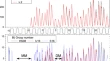
Sun. Figure 23
shows two maps of Lyman α intensity over the full sky. The left panels show the
hemisphere in the direction of the Sun, thus reflecting activity on the far side of the Sun. The middle
panels show the hemisphere in the antisunward direction, which is where activity from the disk
visible from the Earth (and SOHO) would propagate. During the first time period (top row), the
front side of the Sun shows an active region, which lights up the emissions coming from the
antisunward direction (top middle frame). On the other hand, the emissions associated with coronal
activity shown in the second time period (bottom row) clearly light up the sky in Lyman α
measurements (bottom middle frame). From these correlations it can be deduced that during the
first time period there were no active regions in the far side of the Sun (top left frame), while
there was an active region during the second time period (bottom left frame). The latter was
indeed verified as the active region rotated with the Sun to be visible from the Earth. While this
method is not accurate enough to provide sufficiently detailed predictions at Earth orbit, it is a
good demonstration of the possibilities that we have for long-term (2-week) predictions in the
future.
|
| http://www.livingreviews.org/lrsp-2007-1 | This work is licensed under a Creative Commons Attribution-Noncommercial-No Derivative Works 2.0 Germany License. Problems/comments to |