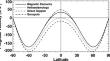
The action of potential reconnection is further enhanced by the pressure pulse from the compressed
plasma. Rosenberg and Coleman (1980
) studied the behavior of Bz around sector boundaries extensively
and explained it in terms of the ballerina model (see Figure 8
): At a sector boundary the current sheet
must necessarily be inclined versus the ecliptic plane, implying the existence of non-zero Bz components. At
the transitions from well within one sector (with Bz = 0) to well within the other sector (again with
Bz = 0) the observer will see a Bz < 0 first and, after crossing the stream interface, Bz > 0.
This applies for any sector crossing, positive to negative and vice versa, as long as the general
dipole of the Sun maintains its orientation. Once the Sun’s dipole is reverted (around solar
activity maximum), the sequence of Bz excursions is also reverted. This reversal was indeed
confirmed (Rosenberg and Coleman, 1980). The CIR scheme in Figure 10
illustrates that the
density profile in the compression region (with its increased ram pressure) is very asymmetric
with respect to the sector boundary. Thus it matters a lot on which side the Bz < 0 excursion
occurs, be it on the low pressure side before the boundary or at the high pressure side behind
it. This phase shift between Bz < 0 and the pressure pulse varies with the 22-year magnetic
solar cycle and is superimposed on the well-known 11-year modulations. Indeed, there were
some unexplained 22-year periodicities in geomagnetism reported by, e.g. Chernosky (1966)
and Russell (1974).
There is another fundamentally different mechanisms causing geoeffective Bz south swings:
Solar wind high-speed streams are dominated by large-amplitude transverse Alfvénic fluctuations
causing major excursions of both the proton flow and the IMF vector on time scales of minutes to
hours (Belcher and Davis Jr, 1971), see also Marsch (1991) and Tu and Marsch (1995). They corotate
with the Sun, often for several months. Once these high-speed streams reach the Earth, the occasional
southward deflections of the IMF due to the Alfvén turbulence stir medium level geomagnetic activity
(see Tsurutani and Gonzalez, 1987
). Bartels (1932
), had postulated “M-regions” on the Sun as
sources of these geomagnetic effects. The close association between high-speed streams and
M-regions had already been noted in the earliest solar wind observations from the Mariner 2 space
probe in 1962 (Snyder et al. (1963), see also Schwenn (1981
)). Tsurutani and Gonzalez (1987
)
and Tsurutani et al. (2004a) inspected the effects of high-speed streams on geomagnetism in terms of
what they called “high-intensity long-duration continuous AE activity (HILDCAA) events”
(Figure 11
). Remember that the compression and deflection of the plasma flow in the CIRs in
front of high-speed streams may also lead to geomagnetic activity (Schwenn, 1981). It does
not matter whether the steepening at the CIRs has already led to the formation of corotating
shocks or shock pairs at the CIRs, a process which only rarely occurs inside the Earth’s orbit
(see Schwenn, 1990).
|
The recurrence of this particular type of geomagnetic activity every 27 days, i.e., exactly in the rhythm
of solar rotation, had led Bartels (1932
) to postulate the existence of M-regions on the Sun already in the
1930s. He thought they were long-lived stable regions on the Sun which emit certain particles capable of
stirring geomagnetism. After all, he was strikingly right except for one aspect: these M-regions are not to be
sought in active regions on the Sun, as he thought, but rather in the inactive parts: the M-regions are
associated with the coronal holes representative of the inactive Sun, and the geomagnetism is
stirred by the streams of high-speed plasma (with their Alfvénic fluctuations) emanating from
them.
A pretty illustration of the close relation between interplanetary magnetic field, coronal holes, solar wind
streams and geomagnetic effects was given by Sheeley Jr and Harvey (1981
), shown in Figure 12
. In the
upper half, all patterns are rather regular products of the inactive Sun. Those data were from the three
years before activity minimum in 1976. With the new activity rising from 1977 on, transient processes
disturbed the regular stream pattern and caused sporadic strong geomagnetic storms: products
of the active Sun. It is important in the context of space weather to always remember this
distinction.
|
| http://www.livingreviews.org/lrsp-2006-2 |
© Max Planck Society and the author(s)
Problems/comments to |