|
What looks like the skirt of a spinning ballerina is the warped separatrix between positive and negative solar magnetic field lines dragged out into interplanetary space by the radially out-flowing solar wind plasma. This separatrix carries an electric current in order to allow the magnetic polarity switch and is thus called heliospheric current sheet. It is formed on top of the closed magnetic structures at the transition between closed and open flux tubes, i.e., generally in the middle of the near-equatorial belt of activity. If the spinning skirt passes an observer sitting, say, at the Earth, he would notice a polarity switch and call it a crossing of a magnetic sector boundary. The size and number of magnetic sectors is closely related to the structure of the underlying corona. i.e., the shape of the activity belt and the coronal holes, respectively. The field lines are curved like Archimedean spirals: they denote the locations of radially flowing plasma parcels that have been released from the same source on the rotating Sun at different times (in honor of their discoverer, these spirals are called Parker spirals, see Hundhausen (1972)). Since the spiral angle (∼ 45∘ at 1 AU on average) depends on the flow speed, streams of different speed from contiguous sources begin interacting with each other on their way out into the heliosphere. Note though that the spiral winding does not concern the meridional component of the IMF.
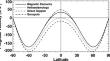
The large polar coronal holes are the sources of high-speed solar wind. The emission of slow solar wind is sharply confined to a belt of about 30∘ width in latitude centered at the warped current sheet. The warps of both the current sheet (which can be taken to be the heliomagnetic equator, (Schulz, 1973)) and the coronal hole boundaries with respect to the heliographic equator allow some high-speed streams to extend to low latitudes so that they become observable at times even in the plane of the ecliptic. This occurs preferentially in the 2 years before activity minimum, when the large-scale coronal structure is rather stable, and high-speed streams reappear at the same heliographic longitudes for many solar rotations.
At times of minimum solar activity there are almost no warps left in the current sheet which is then
plane like a disk lying very close to the plane of the heliographic equator. This is demonstrated in Figure 9
(from Schwenn et al. (1997
)) where two images registered by the LASCO coronagraphs on board SOHO in
early 1996 were merged. They give a very typical example of the appearance of the extended corona at
activity minimum. The inner part was taken in the light of the green coronal emission line at 530.3 nm
produced by Fe XIV ions at temperatures of 2 × 10⁶ K. This spectral line is particularly well-suited to
outline hot magnetic structures in the inner corona. The outer part taken in white light shows the
larger-scale electron density distribution.
|
The large-scale warps of the heliospheric current sheet are caused by localized quadrupole terms of the solar magnetic field. These give rise to similar warps in the coronal hole and stream boundaries and allow them to reach at times across the heliographic equator. Thus, the stream boundaries become effective with respect to longitude. Because of the speed difference, the flows on either side begin interacting with each other with increasing distance from the Sun. In case of stable conditions, these structures appear to corotate with the Sun and are thus called corotating interaction regions (CIRs).
Figure 10
(from Schwenn, 1990
) shows an idealized view of such a CIR and its evolution out to a
distance of approximately 1 AU. At the Sun, the stream interface was found to be very abrupt, which is
indicated in Figure 11
by the rectangular speed increase. With increasing distance, the faster plasma
stream lines, having a smaller Parker angle, start pressing the slow plasma with the more strongly curved
field lines. Compression and deflection of the plasma on both sides of the interface finally yield the typical
profiles found at 1 AU. The total range filled with plasma affected by these interactions amounts to
roughly 30∘ at 1 AU. However, the plasma packed into that range stems from coronal source
regions originally spanning some 70∘ in longitude. Thus, magnetic sector boundaries are often
found close to the stream interfaces at 1 AU and well within the compression regions. Note
though that they usually start off at the Sun with considerable separation that often exceeds
30∘ (Schwenn, 1990
). As a matter of fact, sector boundaries and stream interfaces have basically
nothing to do with each other. Their often-observed proximity at 1 AU should be regarded as
fortuitous.
|
Compression and deflection of the solar wind flow in CIRs has an important consequence for the magnetic field: it undergoes the same compression and participates in the deflection process. Thus, there may arise enhanced out-of-ecliptic field components, particularly in the vicinity of magnetic sector boundaries. Here we have identified one mechanism for generating a southward pointing IMF, which is known to drive geomagnetic disturbances at Earth.
At the backside of fast streams, no interaction of the flows occurs and no CIRs develop, since here the different Parker angles lead to a separation of the flows rather than compression. The transition from the fast to the slow state is found to extend over some 60∘ at 1 AU. However, the location of the original stream boundary can be identified from the abrupt change in the element abundance and the ionization state (Geiss et al., 1995). Further, mapping back the flow to the Sun assuming a strictly radial flow at the locally measured speed, the original rectangular profile at the Sun is nicely reconstructed.
With increasing distance from the Sun, the compression waves at the CIRs steepen to finally form corotating shock waves (see Gosling et al., 1976). There are fast forward shocks at the front side (propagating into the slow-wind side) and fast reverse shocks traveling seemingly backward (propagating into the fast wind coming from behind). The formation of CIR shocks contributes to further eroding the originally steep stream profiles.
Corotating shocks at CIRs, in a manner similar to that of transient-related interplanetary shock waves and planetary bow shocks, can accelerate ionized particles to considerable non-thermal energies (see, e.g. Scholer, 1999). At times near activity minimum CIRs could be identified in plasma measurements by Ulysses (at 4 AU) at latitudes up to some 40∘. At higher latitude, there was nothing but high-speed wind encountered. However, energetic particles apparently associated with CIR shocks have been observed at much higher latitudes (McKibben et al., 1995), to which the CIR shocks do not propagate (Gosling and Pizzo, 1999). That means that there must be a magnetic connection between these high latitudes and those lower latitudes where particles energized at CIRs can be injected. It may be the combined effect of differential rotation of the photosphere, rigid rotation of the corona at the equatorial rate, and the offset between the Sun’s rotational and magnetic axes that allows near-equatorial field lines to connect to high solar magnetic latitude regions (Fisk (1996), see also Posner et al. (2001)). This mechanism transfers information on the corotating stream structure to latitudes where the stream structure itself is not discernible.
A second such mechanism results from meridional “squeezing” of compression regions, as had been observed by Burlaga (1983). He concluded that compression regions may extend over larger latitudinal ranges than the high-speed streams causing them. Of course, such squeezing would imply meridional flows (Siscoe and Finley, 1969) and magnetic field excursions within these regions. This is a second mechanism for generating Bz south of the IMF. Without knowing this effect, an observer of geomagnetism at the Earth might be surprised by the sudden appearance of southward Bz completely “out of the blue.”
| http://www.livingreviews.org/lrsp-2006-2 | This work is licensed under a Creative Commons License. Problems/comments to |