|
The realization of large SEP events being driven by CME shock waves rather than by solar flares meant
a major paradigm change in the early 1990s (see Reames et al. (1996
) and references therein). After all,
SEPs may become a tool to probe the shock and topology of the shock. By comparing complete
intensity-time profiles of SEPs from several spacecraft one may obtain self-consistent models of the evolving
structures.
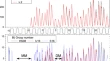
Figure 23
(from Reames et al., 1996
) shows the time profiles of SEP fluxes as seen by observers
viewing a large CME shock from 3 different longitudes. The left hand panel shows what an observer located
east of the CME will see. Since he is magnetically well connected to some point along the nose shock early
on, he will notice a rapid rise of SEPs. The decline is due to the fact that he will be connected with
increasingly weaker parts of the eastern shock flank. Another observer stationed near the central meridian
will see a slower initial rise since he is connected with the western shock flank. Then, due to a large
extended shock front, he is always well-connected until the shock passes: thus, he sees flat profiles (middle
panel). An observer located on the western flank of the CME is poorly connected with the distant
western shock flank until after the shock passes. Then he is connected (on the backside of the
shock) with the powerful nose of the shock and encounters high SEP fluxes for quite some
time.
|
It is now widely agreed that SEPs come from two different sources with different acceleration mechanisms working: The flares themselves release impulsive events while the CME shocks produce gradual events (see the terminology discussion by Cliver and Cane, 2002). The SEPs from flares often have major enhancements in 3He/4He and enhanced heavy ion abundances, because of resonant wave-particle interactions in the flare site. The ions usually have usually very high ionization states. However, the most intense SEP events, also with the highest energies, are produced by CME driven shocks. These SEPs reflect the abundances and ionization states of the ambient coronal material.
The terms impulsive and gradual originally came from the time scales of the associated X-ray events,
but nowadays they are applied to distinguish the time scales of SEP events. In fact, the time
profiles of impulsive and gradual SEP events look rather different as is shown in Figure 11
of Reames (1999
). The gradual event is due to an erupting filament as part of a CME, with no
accompanying flare. The impulsive events were associated with several impulsive flares, but
without any CME signatures. The gradual event is dominated by protons, with a small peak at
shock passage. The smooth and extended time profile comes from continuous acceleration at the
moving CME shock. In the impulsive event the electron fluxes are higher than those of the
protons and those of the gradual event, respectively. The comparatively short duration of the
impulsive event is determined by scattering of the particles as they traverse interplanetary
space.
The differentiation between these two types of SEP events is now rather straightforward and unique. Some statistical analyses revealed interesting facts. Reames (1999) compared the “source longitude” of the associated flares for the two types. The distribution of gradual events was found to be almost uniform across the face of the Sun. Determination of a “source longitude” is complicated since many gradual SEP events apparently originated from behind the Sun’s limb, and many CMEs driving gradual SEP fluxes were not associated with flares. After all, there is no doubt about a pretty uniform distribution. In contrast, the impulsive event sources are clearly concentrated in the western half of the Sun with a surprisingly sharp peak at W60. That is about the source longitude of the “average” Parker spiral that connects the Earth to the Sun. Apparently, these impulsive SEPs are injected right into and contained well within “their” flux tube. They do not have much chance to escape to neighboring field lines. The comparison of the distributions indicates that the broad distribution of gradual events can not result from cross-field diffusion, since there is no reason why this same process would not also broaden the distribution of impulsive events. The broad distribution of gradual events suggests the existence of large-scale shock waves that can easily propagate across field lines. The long-standing problem “How can flare-accelerated particles be transported to the often very distant field lines where they are observed?” that had puzzled whole generations of scientists (see, e.g. Kunow et al., 1991) can finally be considered solved.
There is an important implication with respect to space weather effects: The direct injection of impulsive SEPs affects only a narrow regime in space. But the shock fronts driven by CMEs can extend over large spatial angles and thus can fill them with high fluxes of SEPs (Simnett, 2003). In particular, the very big and fast events produce the highly relativistic and most dangerous particles and spread them almost all around the Sun, covering nearly the whole heliosphere.
There is a vast literature on the important issue of elemental abundances in SEP fluxes. Most impulsive
flares show not only substantial enhancements of the 3He/4He ratio but also enhanced heavy ion contents,
as compared to oxygen (Reames and Ng, 2004). It is thought that these anomalies contain information on
the acceleration and propagation processes. These aspects will not be addressed further in this review. The
interested reader can easily find (e.g., by searching the
http://www.adsabs.harvard.edu/) relevant papers by authors such as Reames,
Klecker, Cane, Mason.
| http://www.livingreviews.org/lrsp-2006-2 |
© Max Planck Society and the author(s)
Problems/comments to |