3.8 Type III radio bursts
Major fractions of the flare-accelerated electrons and protons escape into space (to be discussed in more
detail in the next Section 3.9), guided by the magnetic field lines that are carried out into
the heliosphere by the evolving solar wind. Injections of electrons in the keV energy range are
accompanied by radio wave emission with frequencies from MHz down to few kHz. These so-called
type III radio bursts (Wild, 1950) are generated in a two-step process (see also Figure 15
from Gurnett et al., 1980
): 1. electrons accelerated in solar flares to energies of some keV are
streaming away from the Sun and excite plasma oscillations locally, all the way from the corona
into the distant heliosphere, the frequency fp being determined by the local electron density
ne:
with fp in kHz and ne in cm−3. 2. These plasma oscillations (sometimes also called Langmuir waves) are
converted to escaping electromagnetic radiation (of the same frequency or its harmonic) by non-linear
wave-wave interactions. The resulting radio waves can be picked up by appropriate receivers in space.
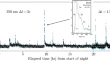
Because of the outward travel of the electrons through the radial density gradient the wave frequency
gradually decreases with time, and their onset times are gradually delayed. That leads to the characteristic
frequency variation of type III bursts as shown in Figure 16 from Kellogg (1980
). In many cases, there is
an overlaid strong and more spiky signal at very low frequencies observed. It is caused by the plasma
oscillations excited locally upon arrival of the electrons at the position of the observing spacecraft. In the
case shown in Figure 16, the local plasma density of 7.5 cm−3 would correspond to a local
plasma frequency of 24.6 kHz, which is indeed at the intensity maximum of the observed plasma
oscillation spectrum. Note that the onset times of the oscillations and the waves are almost
identical.
Modern antenna systems onboard spaceprobes allow determination of the direction of the source of the
type III radiation. The frequency itself is a measure of the source’s plasma density which, in conjunction
with an assumed density model, is a measure of the radial distance of the source. This way, the location of
any particular radio source along the path of the type III electrons can be determined. Indeed, the actual
shape of the Parker spiral along which these electrons have to move could be experimentally
verified (Reiner et al., 1995). Simultaneous radio measurements from two distant spacecraft allow
rather precise triangulation of the radiation sources and a stereoscopic view of the electron
beam path, even without any assumption of a density profile (Baumback et al., 1976; Gurnett
et al., 1978).
The type III electrons have a rather wide energy spectrum. Thus, their travel times to an in situ
observer located at some distance from the Sun will vary considerably. That is indeed observed, as is shown
in the bottom panel of Figure 17 (from Lin, 2005
): the 27 keV electrons arrive about 20 minutes later
than the 517 keV electrons.