|
Because of their small masses, electrons are less important than ions for the solar wind dynamics. Yet,
they ensure quasineutrality, constitute an electric field through their thermal pressure gradient and
carry heat in the skewness of the thermal bulk and the suprathermal tail of their VDFs, which
are determined mainly by the large-scale interplanetary magnetic field and the self-generated
electrostatic potential, by Coulomb collisions in the thermal energy range at a few
,
and by various kinds of wave-particle interactions. The electrons are subsonic, i.e. their mean
thermal speed considerably exceeds the solar wind (ion) bulk speed. Suprathermal electrons (at
several
) may be considered as test particles that quickly explore the global structure
of the heliospheric magnetic field, which consists usually of open field lines mostly anchored
in coronal holes (CHs), but may temporarily attain the shape of magnetic bottles or closed
loops.
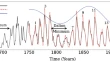
Figure 1
shows in the upper frame a typical solar wind electron VDF measured in a fast stream
at
, after Pilipp et al. (1987a
). A strong heat flux tail is clearly visible as a distinct
bulge (the “Strahl”, Rosenbauer et al., 1977
) in the VDF along the magnetic field direction
(indicated by a dashed line). The main colder core population is surrounded by hotter halo
electrons that amount to a few (typically four) percent in relative number density. The lower frame
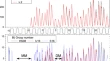
of Figure 1
after Maksimovic et al. (2005
) indicates that the strahl is declining with radial
distance from the Sun, whereas the halo is relatively increasing, perhaps by scattering of strahl
electrons.
The collisional free path
is according to Table 1 much larger than the temperature gradient scale
height
. A polynomial expansion of the electron VDF about a local Maxwellian is found to badly
converge (see also Dum et al., 1980
), and thus an expansion like in the subsequent Equations (23
) or (26
)
is certainly not appropriate for solar wind electrons. The reason is that they are global players and reflect,
as is obvious from their strongly skewed VDF, the large-scale inhomogeneity of the solar wind and coronal
boundary conditions, as well as local collisional processes that shape the central part of their
VDF. This was emphasised long time ago by Scudder and Olbert (1979a
,b
) in analytical model
calculations.
|
In detailed kinetic simulations, Lie-Svendsen et al. (1997
) numerically integrated an approximate kinetic
equation derived from the basic Boltzmann Equation (9
) to be discussed later, and could reproduce
essential features of the observed VDFs. They concluded that electrons do not matter dynamically in solar
wind acceleration. The radial evolution of thermal electrons due to expansion and collisions was studied in
the fluid picture by Phillips and Gosling (1990). As we will discuss below, Landi and Pantellini (2001
)
recently carried out fully kinetic simulations of electrons in a coronal hole and the associated solar wind. We
come back to these theoretical issues in Section 7, where kinetic models for the corona and solar wind are
discussed.
The magnetic field topology has a strong influence on the shapes of the velocity distributions, which can
observationally be considered to be composed of three main components, a cold and almost isotropic
collisional core, a hot variably-skewed halo population, and in fast solar wind often a narrow field-aligned
strahl. The basic electron characteristics were first measured and described by Feldman et al. (1975
). A
comprehensive modern review was given by Feldman and Marsch (1997
). The VFDs have often been
modelled by only two convecting bi-Maxwellians as illustrated in the top part of Figure 2
, taken from the
Helios observations published by Pilipp et al. (1987a
). On open field lines in the fast wind, the VDF
usually develops a high-energy extension with a very narrow pitch-angle distribution only 10 – 20
degrees wide. This electron strahl population responds sensitively to the local magnetic field
orientation.
Common observations of the same plasma parcel of the wind by instruments on different spacecrafts,
when being radially aligned, allows one to characterise the radial gradients of electron thermal parameters.
The core temperature is found to vary widely between isothermal and adiabatic, while the halo
temperature behaves more isothermally. The halo density falls off more steeply in dense plasma.
Electron parameters have been studied by Ulysses in the distance range from
to
(McComas et al., 1992
), where the halo is found to represent always about 4% of the total electron
number. Since there is no reason for this ratio to be constant if the halo and core particles
were completely separated, it appears that halo particles are not entirely decoupled from the
core.
Solar wind electron parameters, in comparison with other measurements made on Ulysses, have also been derived from quasi-thermal noise spectroscopy, a novel method which was introduced by Meyer-Vernet and Perche (1989) and then exploited by Maksimovic et al. (1995) and Issautier et al. (1996).
Solar cycle variations in the electron heat flux have been studied by Scime et al. (2001
), who did not
find any significant dependence of the heat flux on the cycle or heliographic latitude. On average, the heat
flux radially varies according to a power-law scaling,
, but there is no significant correlation of
its magnitude with the solar wind speed. Concerning the electron temperature in the ambient solar wind,
typical values and a lower bound were inferred from ISEE data at
in a paper by Newbury
et al. (1998). In particular, the temperature ratio,
was investigated and found to depend
systematically on the wind speed. The average ratio declines from about
at
to about
at
.
The break-point energy in the electron spectra of Figure 2
scales on average like seven times the core
temperature, a result which was predicted by a kinetic theory for the electrons when being mediated by
Coulomb collisions alone (Scudder and Olbert, 1979a
,b
). Such value of the break-point energy is also
consistent with its interpretation as being equal to the electrostatic interplanetary potential that traps
thermal electrons. Typical values of the interplanetary potential
at
are
(Pilipp
et al., 1987a
,b
). For the importance of
see the following Subsection 3.3 and the discussion in the
paper by Maksimovic et al. (2001). Concerning the radial profile of the mean electron temperature,
Meyer-Vernet and Issautier (1998) presented a kinetic model to obtain what they called the generic radial
temperature variation derived from collisionless kinetics. Empirically (Marsch, 1991a
), the temperature
varies between almost isothermal and adiabatic behaviour (that implies
scaling with distance
).
| http://www.livingreviews.org/lrsp-2006-1 |
© Max Planck Society and the author(s)
Problems/comments to |