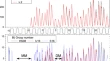
As Figure 20
demonstrates, that in the presence of a large-amplitude Alfvén-cyclotron wave the power
of the waves corresponding to the linear instability strongly decreases (see the fading of the left grey bar
with the relative amplitude
, rising from
to
). There is low wave activity in the third
quadrant, except for the power at
, which may be due to a parametric decay. This
region would be expected to be stable in a linear system with
. These properties show that
there is a stabilization of the linear instability (Gomberoff, 2003
), due to the presence of the
large amplitude wave that is visible as dark bar in the lower frame (b) at
.
The beam drift is large,
, and the beam density sizable,
, with
. Finally, note that the beam-modified linear dispersion relation is nicely outlined by the
two curves crossing at the origin. On these lines the fluctuation level clearly appears to be
enhanced.
|
These simulation findings are particularly important in the light of the results presented in the previous
section, in which the observed proton double beams in the fast solar wind were found to be
largely stable. However, in the standard linear stability analyses (as discussed in the previous
section) the presence of the large-amplitude Alfvénic turbulence, which is ubiquitous in the
fast solar wind (Tu and Marsch, 1995), was not accounted for. But Kaghashvili et al. (2004
)
showed that the relative streaming between proton components decelerated among non-linear
low-frequency Alfvén waves. Some of their results are shown in Figure 21
, which gives the
normalised proton beam drift versus time in gyroperiods for various ambient Alfvén wave
amplitudes.
|
The evolution of streaming minor ions in the presence of large-amplitude Alfvén waves is similar to weak proton beam deceleration. Kaghashvili et al. (2003) showed that minor ion deceleration is associated with the development of a compressional wave component. But they did not relate this with instability, and their simulation results show that minor ion deceleration only begins after an onset time. Therefore, minor ion deceleration may be related with an effective beam instability.
To summarise, Gomberoff (2003), Gomberoff et al. (2003
), Araneda and Gomberoff (2004) and
Kaghashvili et al. (2004) all have clearly shown that finite-amplitude Alfvén waves have a parametric
(often stabilizing) effect on parallel-propagating magnetosonic waves that are generated by a beam
instability. Similarly, we may conclude that the obliquely-propagating proton-proton Alfvén cyclotron
waves generated by a beam instability are altered by finite-amplitude Alfvén waves. To verify all these
theoretical findings by an analysis of measured wave and particle data is an important future
task.
Dubinin et al. (2005
) analysed the non-linear evolution of differential ion streaming with the non-linear
multifluid MHD equations and showed that the cold ion beam-plasma system possesses an equilibrium
with a remnant of differential streaming. The plasma may, through the non-linear action of the
hydromagnetic waves, attain such a dynamic equilibrium state. It is shown that at zero plasma beta the
differential speed between the alphas and protons can range between
and
, and for a
proton double beam between
and
. The waves involved are either the Alfvén or
magnetosonic modes, depending upon the beam speed, whereby Alfvén waves enable larger differential
speeds.
| http://www.livingreviews.org/lrsp-2006-1 |
© Max Planck Society and the author(s)
Problems/comments to |