On the Sun the differential rotation is observed in relative motion of sunspots and can be expressed in the form
where On stars these characteristics can be estimated from observations with various methods, for instance:
Fourier analysis of light curves (Lanza et al., 1993), cross-correlation of successive stellar Doppler images
(Donati and Collier Cameron, 1997
), direct spot tracking (Collier Cameron et al., 2002), Fourier
transform of rotationally broadened line profiles (Reiners and Schmitt, 2002), parameter fit in
Zeeman–Doppler imaging (Petit et al., 2002
), through asteroseismology (Gizon and Solanki, 2004) and
from spectro-interferometric observations (de Souza et al., 2004). For slowly rotating stars of the solar
type, analysis of disk-integrated Ca ii K line core emission appears to be a promising method (Donahue
et al., 1996
; Hempelmann and Donahue, 1997).
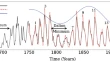
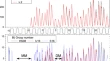
Long-term photometric monitoring of starspot modulation reveals changes in the seasonal rotation
period which indicate the presence of differential rotation on stellar surfaces and of changes in spot
latitudes (Hall, 1991a; Henry et al., 1995
; Messina and Guinan, 2003
). Confronting the range of
seasonal variations and the mean rotation period yields a possible correlation between them in the
sense that slower rotators show larger period variations. A majority of stars show, however, a
significantly smaller rotational shear than that observed on the Sun. Similar behaviour is found in
periods obtained from variations of chromospheric Ca ii H & K emission-line fluxes. Over
timescales of many years, the rotation period was found to show a sine-like variation which
can be attributed to a solar-type activity cycle (Donahue et al., 1996). Note, however, that
the seasonal period variations yield only lower limits of the rotational shear as they represent
rotational rates spread over the range of latitudes where active regions erupt during the stellar
cycle.
Using the Fourier transform method Reiners and Schmitt (2003a,b) derived differential rotation in
terms of
of a sample of rapidly rotating F0–G0 dwarfs and found that it is more common in slower
rotators, in agreement with the previous findings. Moreover, the differential rotation in more
active stars seems to diminish to values which cannot be measured with the Fourier transform
technique.
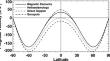
In such cases, cross-correlation of successive stellar Doppler images is a helpful alternative. It was first
performed by Donati and Collier Cameron (1997
) for the active young dwarf AB Dor and revealed the
solar type differential rotation with the equator rotating faster than the polar region (see Figure 12
). The
parameter fit using DI or ZDI developed by Donati et al. (2000) and Petit et al. (2002) is the next
step in using inversion techniques. It was applied to a small sample of active G2–M2 dwarfs,
all showing a solar type differential rotation (Petit et al., 2004; Barnes et al., 2005). This
sample revealed a clear dependence of the rotational shear on spectral class, indicating the
differential rotation to be negligible in M dwarfs and very strong in G dwarfs. The Sun, however,
deviates from the correlation. In contrast to the results for early F and G dwarfs, no significant
dependence of
on rotation rate was found. An interesting finding though is that the
differential rotation is different when estimated from cool spots or magnetic regions, and that it
undergoes temporal fluctuations on time-scales of one to a few years (Donati et al., 2003a
). Note,
however, that the lack of spatial resolution and spot growth and decay as well as their systematic
proper motions, can significantly affect the derived values of the differential rotation. Also,
since spot latitudes strongly depend on the inclination of the rotational axis (see Section 4.2),
uncertainties in the inclination may result in systematic errors in the deduced differential rotation
law.
| http://www.livingreviews.org/lrsp-2005-8 |
© Max Planck Society and the author(s)
Problems/comments to |