4.3 Zeeman-Doppler Imaging
As an extension of the temperature and abundance mapping of the stellar surface, a magnetic
Zeeman-Doppler imaging (ZDI) method was introduced by Semel (1989
) and further developed by Donati
et al. (1989), Semel et al. (1993), Brown et al. (1991
), and Donati and Brown (1997
). The technique is
based on the analysis of high-resolution spectropolarimetric data and allows for disentangling magnetic field
distribution on the stellar surface due to different Doppler shifts of Zeeman-split local line profiles in the
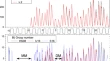
spectrum of a rotating star (Figure 3). In the absence of rotation, the net circular polarisation signal in
spectral lines would be zero due to mutual cancellations of contributions of regions of opposite field
polarity.
Zeeman signatures in atomic lines due to starspots are expected to be extremely small, with typical
relative amplitudes of 0.1%. Detecting them requires measurements of polarisation with noise level in Stokes
as low as
, while the current instrumentation allows for the best relative noise level of
.
Semel (1989) and Semel and Li (1996) proposed a multi-line approach for increasing the signal-to-noise
(S/N) ratio of the measured polarisation, which has resulted in first detection of the circular polarisation
signal in a cool star (Donati et al., 1997
). A combination of Stokes
profiles using a multi-line technique
called Least Squares Deconvolution (LSD) is based on the weak field approximation, i.e., one assumes that
the magnetic splitting of spectral lines is smaller than their local Doppler broadening. In this
case the Stokes
signal is proportional to the derivative of the intensity profile
, i.e.,
where
is the effective Landé factor and
is the wavelength of the
-th spectral line. It is assumed
further that the local line profiles are self-similar and scale in depth and width with the central depth
and wavelength, i.e.,
where
is a so-called mean Zeeman signature, which is constant for all lines. The LSD Stokes
profile can be obtained as a sum over many individual lines:
Blends and splitting patterns should be treated explicitly for each line. The gain factor in the S/N ratio can
be as large as 30 when using more than 2000 line profiles. The LSD technique allowed for detection of
magnetic fields on various types of cool stars, from pre-main-sequence stars to evolved giants (Donati
et al., 1997). It was also used for temperature mapping using Stokes
observations of faint stars with
short rotational periods for which high signal-to-noise spectra cannot be obtained through longer exposure
times.
Applying an inversion technique, similar to those used for Doppler imaging (see Section 4.2), to all four
Stokes parameters, one can recover the distribution of the temperature and magnetic field vector over
the stellar surface. Three numerical codes based on the Maximum Entropy method (Brown
et al., 1991; Hussain et al., 2000) and the Tikhonov regularisation (Piskunov and Kochukhov, 2002
) have
presently been developed. In practice, however, measuring the full Stokes vector for cool stars is difficult,
because magnetic signatures in Stokes
and
are considerably smaller than in Stokes
.
Obtained Zeeman-Doppler images of cool stars are based on measurements of only Stokes
and
are certainly not unique and provide limited information for the interpretation. A lack of
information on different components of the magnetic vector can be overcome by assuming a certain
relation between the components. For instance, Hussain et al. (2001) prescribed the field to
be potential and reconstruct its distribution from circularly polarized line profiles. Piskunov
and Kochukhov (2002) suggested a special type of regularisation based on spherical harmonic
expansion. In this case the field distribution is forced to take the form of such an expansion
which is acceptable only for stars with clearly dominating multipole structures like, e.g., Ap
stars.
In the inversion procedure three components of the magnetic field vector are generally represented by
radial, azimuthal, and meridional fields. To some extent they contribute to the line of sight component
observed in Stokes
at different rotational phases and different Doppler shifts. For instance, the radial
field will dominate the Stokes
near the centre of the stellar disk, while the azimuthal field will be most
noticeable in the circular polarisation near the stellar limb. This allows to recover some parts of the
magnetic field components from Stokes
observations. An example of such restoration is shown in
Figure 4. When interpreting the results of Zeeman-Doppler images obtained only from Stokes
and
,
one has to take into account that the magnetic field distribution is underdetermined for each
component and that there might be a cross-talk between different components (Donati and
Brown, 1997).