3.4 Topological models of anchored fields
Much of the literature on the topology of anchored magnetic fields concerns the properties of the footpoint
mapping. Most of this literature cleaves into two categories according to the assumed form of the photospheric
normal field and the level of detail with which the mapping is represented. Some models, hereafter called
pointwise mapping models, consider the detailed structure of the point-to-point footpoint mapping
.
The alternative, called Magnetic Charge Topology (MCT), reduce the mapping to its connectivity between
distinct photospheric sources: regions of unipolar photospheric flux surrounded by a strictly field-free “sea”
(
) .
Some models make a further simplification by replacing each region with a point magnetic charge - the
leading order in its multipole expansion. In contrast to this intermittent distribution, pointwise mapping
models generally assume the normal photospheric field is a generic, non-intermittent function on the
surface, vanishing only along curves known as polarity inversion lines (PILs).
It is useful to organize the existing literature into these categories, because their different approaches
lead to different concepts of topology and different topological elements; for example they use mutually
inconsistent definitions of separatrices. While both seek to describe, in their own way, a common underlying
reality, they do so using subtly different conceptual frameworks. The situation is further muddled by
their use of the same terms, such as separatrix, to denote different things. One rather popular
model, which we call the submerged poles model, appears to defy this categorization. In fact, this
one model is used by some authors as an MCT model and by others as a pointwise mapping
model. We find that formulating rigorous frameworks for each of category, MCT in Section 4
and pointwise mapping models in Section 5, leads to a relatively clear presentation of most
existing literature. We refer briefly to the submerged poles model with the MCT models, but
defer its full presentation to a separate section, Section 6, since it draws elements from both
categories.
The need for two model categories arises partly from the diversity of data. The quiet Sun, for example,
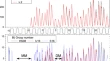
is revealed by line-of-sight magnetograms (see top panel of Figure 7 for an example) to have an intermittent
photospheric field consisting of small unipolar regions, called magnetic elements, separated by distances far
exceeding their own diameters (see Zwaan, 1987, for a review of the hierarchy of photospheric magnetic
fields). This suggests that the magnetic charge topology model would be a good approximation for this
portion of the solar atmosphere. Almost all modeling of the quiet Sun magnetic field uses some version of an
MCT model.
Detailed chromospheric models suggest that the magnetic field expands above these isolated features
until it merges at a merging height or canopy to form a volume-filling coronal field (Kopp and
Kuperus, 1968; Gabriel, 1976). More careful studies of the apparently field-free sea surrounding the
elements (Livingston and Harvey, 1971; Lin and Rimmele, 1999) reveals that it contains an even finer
inter-mixture of smaller positive and negative flux elements. To date this further complication in
the quiet Sun field has been modeled by MCT models with smaller charges (i.e. points with
less magnetic charge, see Schrijver and Title, 2003). It is not clear if future efforts will turn
to pointwise mapping models or be forced to discard topology altogether due to the higher
collisionality, shorter time scales and lower Alfvén speeds in this very complex layer of the solar
atmosphere.
Active region photospheric fields (see bottom panel of Figure 7), on the other hand, are less
clearly separated into distinct unipolar structures and are consequently less amenable to MCT
models. The alternative is to assume the photospheric magnetic field is a non-intermittent
function vanishing only along the PILs. Models of this type consider the point-to-point mapping
function from positive to negative regions. This is almost always the model used when analyzing
time-dependent numerical simulations of active region evolution. The observed active region
field does, nevertheless, appear to be organized into distinct positive and negative regions.
Therefore, the literature includes both MCT and pointwise mapping model analyses of active
regions.