8.2 Open/closed boundaries
Locating the photospheric source of the solar wind requires some kind of magnetic model extending
through the low solar corona, where
, into the super-Alfvénic solar wind. The key topological
elements in any such model are the boundaries between open and closed field lines. Yeh (1978
) presented a
general discussion of the possible topologies of the open/closed separatrices. We neglect at this point those
separatrices between different regions of closed fields since they are topologically identical to cases without
open field discussed at length in the foregoing sections. In the remaining cases, Yeh concluded that
separatrices could either separate open field lines from closed field lines, or they could separate the two
polarities of open field lines. A given closed flux region can either have a compact footprint or its
footprint can surround one or more regions of open field lines (compare Panels a and b in
Figure 23). A compact footprint (one which includes no open field regions) will be enclosed by two
separatrices, connected by a separator contacting the photosphere at two points, as in Panel a. When
the closed region surrounds a section of open flux, as in Panel b, it will form a “crater-like”
enclosure, with separatrices inside and outside intersecting along a closed coronal separator
(Yeh, 1978
).
The most common quantitative model of the global corona is the Potential Source Surface (PSS) model
first introduced by Schatten et al. (1969
) and Altschuler and Newkirk Jr (1969
), and refined by
subsequent investigators. The field is taken to be potential,
, in the region between the
photosphere and an outer shell at
called the source surface (see Figure 24). The solenoidal
condition,
, means that the scalar potential must be harmonic,
, within the range
. The upper boundary,
, is meant to represent the base of the true solar
wind, in which all field is open and approximately radial. The appropriate boundary condition
for this purpose is
, which makes all field purely radial (
) on
the surface. The general solution to Laplace’s equation satisfying this boundary condition is
where
is the associated Legendre
polynomial.
The coefficients
and
are fixed using the lower boundary condition from the
photospheric magnetic field. This boundary condition can, for example, be formulated in
terms of a sequence of magnetograms covering one complete solar rotation (Altschuler and
Newkirk Jr, 1969).
In a complete magnetic field model the outside of the potential field from Equation (28) is
matched to the inside of a heliospheric field. The latter typically consists of field lines tracing
Parker spirals outward or inward along cones from
, as shown in Figure 24. The radial
field at the source surface,
, therefore serves as the “source” of the
heliospheric field. The outward and inward sectors are anchored where
and
,
respectively.
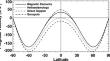
The curve along which
thereby defines the base of the heliospheric current sheet separating
the heliospheric sectors: It is the sector boundary (see Figure 25). At radii approaching the
source surface from below, Equation (28) becomes strongly dominated by its lowest poles,
and
, corresponding to the photosphere’s overall dipole and quadrupole. One
consequence of its low-order nature is that
tends to be very smooth,
vanishing along a single closed curve dividing the
sphere in two. Thus, at least at its base
the heliospheric current sheet is not a discontinuity since
passes continuously through
zero.
The sector boundary is defined by the curve or curves on the source surface where
, as shown in
Figure 25. Were the field purely dipolar the sector boundary would be a great circle on the source surface,
although it would only coincide with the rotational equator in the case
. It is the influence of
the quadrupole (and the higher poles to a lesser extent) which deforms the heliospheric current sheet,
sometimes resulting in four sector crossings per rotation or even multiple distinct unipolar
regions (Hoeksema et al., 1983). Examples of particularly complex configurations are shown in
Figure 26.
Since both
and
vanish everywhere over the source surface, the sector boundary,
, is
a curve of genuine magnetic null points. Such a one-dimensional continuum of nulls is one of the
constructions expressly discounted in the foregoing section (2.4) since it is non-generic. It owes its
appearance now to the definition of the source surface as a surface on which
and
vanish
simultaneously (in general circumstances, these functions would vanish on separate surfaces
which would generically intersect transversally only along curves). These null points are neither
positive nor negative but are all X-type nulls whose neutral direction (along the eigenvector
corresponding to the
eigenvalue) is parallel to the sector boundary curve. Each null
point has two distinct separatrix curves extending downward into the current-free corona: one
forward and one backward (see Figures 24 and 25). For each closed sector curve on the source
surface the forward separatrix curves form a continuous separatrix surface mapping downward to
negative polarity photospheric regions; this is the red curve on the right part of Figure 27.
The backward separatrices form independent separatrix surfaces mapping to positive regions
(the blue curve). These surfaces are the separatrices between open and closed magnetic field
lines. Their footpoints trace photospheric curves which are the theoretical manifestation of
coronal hole boundaries in the PSS model. The coronal field becomes increasingly complex at
decreasing radii and can also contain isolated coronal null points at radii
. Thus
the separatrices leaving the smooth sector boundary may map to fairly complex coronal hole
boundaries.
The topology of a heliospheric field model may be tested against several types of observation. The model
was first developed by Schatten et al. (1969) for comparison to the magnetic sectors observed by spacecraft
at
. This showed that setting
gave a model whose predictions of mean field strength,
sector duration and smoothness in
was in good agreement with the average values observed by
spacecraft. Hoeksema et al. (1982) compared observations to time histories of radial field direction (inward
or outward) predicted by source surface models over 18 solar rotations (1976-1977). The observations
showed four sector boundary crossings per rotation, implying a rather complex heliospheric current sheet.
The PSS model produced a time history agreeing with the observations with a correlation coefficient
of
; the maximum correlation occurred when
. Burton et al. (1994)
compared a PSS model to sector crossings of the ISEE-3 spacecraft and found that not only
were the transitions correctly predicted, but so was the inclination of the current sheet at the
crossings (with a correlation coefficient of
). An independent test was provided by Bruno
et al. (1984), who observed a correlation between the predicted location of the heliospheric
current sheet and the location of maximum K-corona brightness observed from the Mauna Loa
coronagraph.
Originally developed to model the heliospheric magnetic field, the PSS model has also proven useful in
studies of large-scale coronal topology. The separatrices extending downward from the sector boundary,
, form the boundary between open and closed coronal field lines. There is evidence in support of
this interpretation and of the correspondence between open field lines and coronal holes. Coronal holes are
defined observationally by their lower X-ray or EUV emission or by a lack of chromospheric network in He II
emission at
or
. Levine (1982
) found very good agreement between open/closed
boundaries (separatrices) in a PSS model and observed coronal hole boundaries, especially in the period
near solar maximum.
The PSS model has been used to study the evolution of the large-scale corona including its coronal holes
(Sheeley Jr et al., 1987
; Wang and Sheeley Jr, 1993; Wang et al., 1996; Luhmann et al., 1998
).
Evolution of the photospheric field leads to changes in the overlying coronal field extending all the way to
the source surface. The open/closed boundaries extend from the source surface, so the motion of their
photospheric footprint need not coincide with photospheric motions. This was found to give a compelling
explanation for the fact that coronal holes were observed to rotate rigidly in spite of the photosphere’s
differential rotation (Levine, 1982; Sheeley Jr et al., 1987). The implication of this model is that field lines
anchored to the photosphere undergo reconnection in order to open or close as the separatrix sweeps over
them. While the need for such reconnection is predicted by the PSS model, its dynamics cannot be
studied in a quasi-static model (Wang and Sheeley Jr, 2004). There has been observational
confirmation of reconnection occurring at coronal hole boundaries (Madjarska et al., 2004). Luhmann
et al. (1998) propose that CMEs are a more dramatic manifestation of the need to open magnetic
fields.
A still more global consequence of this application is its prediction of how the net open flux
responds to the photospheric field. The open flux in the PSS model can be calculated by integrating
over the entire source surface. The field at the source surface will evolve over the solar cycle, principally in
response to the lowest moments of the photospheric flux. As a consequence
tends to reach its
maximum when the dipole moment is largest some time near solar minimum (Wang et al., 2000
). This is in
close agreement with observations (King, 1979
), which must infer the total flux from a few point
measurements as discussed above. Once again the quasi-static model cannot be used to determine how the
open flux is changed, only to predict that it will change. One possibility for increasing the
open flux, discussed further below, is that coronal mass ejections leaving the corona drag open
previously closed field lines (Gosling, 1975
). The subsequent reduction in open flux after solar
minimum could occur only through the reconnection of open field lines to produce more closed
flux.