Granulation, with a typical size of
, is well understood as a convective phenomenon and can be
studied with realistic numerical simulations (see, e.g., Stein and Nordlund, 2000). Supergranules, however,
have remained puzzling since their detection by Hart (1954, 1956
). In a classic paper, Leighton
et al. (1962) reported “large cells of horizontally moving material distributed roughly uniformly over the
entire solar surface” with a characteristic scale of
that are outlined by the chromospheric network;
they suggested that the cells are a “surface manifestation of a supergranulation pattern of convective
currents”. Unfortunately, there is no accepted theory that explains why solar convection should favor a
scale. The solar convection zone is so highly turbulent and stratified that numerical
modeling at supergranular scales has remained elusive (see, e.g., Rincon, 2004, and references
therein).
Simon and Leighton (1964
) presumed that a convective instability due to the recombination of ionized
Helium is at the origin of the distinct supergranular scale. Forty years later, this hypothesis has not been
proved to be right or wrong. The depth of the supergranulation layer is not known either. We note that
Parker (1973) believes that the effect of stratification on convection may imply that supergranules are a
deep phenomenon, with depths in excess of their horizontal diameters. Antia and Chitre (1993) investigated
the stability of linear convective modes in the solar convection zone and found that a few convective modes
dominate the power spectrum, one of which was identified as supergranulation. Using 1D numerical
caculations, Ploner et al. (2000) suggested that the scale of supergranulation may be due to the
interaction and merging of individual granular plumes (see also Rast, 2003). A somewhat related
model was proposed by Rieutord et al. (2000, 2001) whereby supergranulation is the result of a
non-linear large-scale instability of the granular flow, triggered by exploding granules. In the two
previous models, supergranulation is not a proper scale of thermal convection. Regarding the
influence of supergranular flows on magnetic fields, it is well established that a stationary cellular
flow tends to expel the magnetic field from the regions of fluid motion and concentrate the
magnetic flux into ropes at the cell boundaries (Parker, 1963; Galloway et al., 1977; Galloway and
Weiss, 1981).
On the observational side, the original work of Leighton and coworkers has been refined. A variety of
methods have been used to characterize the distribution of the cell sizes. A characteristic scale
can be obtained from the spatial autocorrelation function (see, e.g., Hart, 1956; Simon and
Leighton, 1964; Duvall Jr, 1980
), the spatial Fourier spectrum (see, e.g., Hathaway, 1992; Beck, 1997
),
and segmentation or tessellation algorithms (Hagenaar et al., 1997). Although definitions vary, average cell
sizes are in the range
. It is unclear whether there is a variation of cell sizes with latitude:
Rimmele and Schroeter (1989) and Komm et al. (1993a) report a possible decrease with latitude, Berrilli
et al. (1999) an increase, and Beck (1997) no significant variation. The typical lifetime of the
supergranular/chromospheric network is found to be in the range
(e.g Rogers, 1970; Worden and
Simon, 1976; Duvall Jr, 1980
; Wang and Zirin, 1989). The rms horizontal velocity of supergranular flows
is known to be about
(see, e.g., Hathaway et al., 2000). The vertical component of the
flows, however, has been extremely difficult to measure (see, e.g., Giovanelli, 1980) or infer
(November, 1989). Indeed, Miller et al. (1984) caution that Doppler velocity measurements at the
cell boundaries may be polluted by the network field. Estimates of the rms vertical flow are
provided by Chou et al. (1991) and Hathaway et al. (2002) who find speeds of about
(the topology of the vertical flows is largely unknown). Even more difficult to measure are
the related temperature fluctuations. Observers have searched for the thermal signature of a
convective process, i.e., rising hot material at the cell centers and sinking cool material at the cell
boundaries. Unfortunately, answers vary too widely (see Lin and Kuhn, 1992, and references
therein).
Estimates of the pattern rotation rate of supergranulation can be obtained by correlation tracking
techniques. Duvall Jr (1980
) and Snodgrass and Ulrich (1990
) used Doppler scans separated in time by
. The results indicate that the equatorial rotation of the supergranulation pattern is
faster than the spectroscopic rate (Snodgrass and Ulrich, 1990
) by about 4% and faster than
the magnetic features (Komm et al., 1993b
) by about 2%. Duvall Jr (1980
) also considered
same-day scans with
and found a slightly smaller pattern rotation rate than for
.
It was suggested by Foukal (1972) that the difference between the rotation of magnetic features and the
spectroscopic rate may be due to magnetic structures being rooted in deeper, more rapidly rotating layers.
Supergranules must also sense increase rotation in the shear layer below the surface. However,
Beck (2000) remarks that the pattern rotation of supergranulation measured from correlation tracking
with
is significantly faster than the rotation of the solar plasma measured by
helioseismology at any depth in the interior. It is especialy puzzling that the rotation of the
magnetic network is significantly less than that of the supergranular pattern, since small magnetic
elements are believed to be advected by supergranular flows. Hathaway (1982
) suggested that a
faster supergranular rate may be a direct consequence of the interaction of convection and
rotation.
As explained in the following sections, local heliososeismology has become a powerful tool to study the structure and evolution of supergranular flows. In fact, helioseismological measurements have transformed our knowledge of the dynamics of supergranulation.
In order to resolve structures at supergranular scales, Duvall Jr et al. (1996) measured p-mode travel times
at distances shorter than
over an
time interval. Directional information was obtained by
cross-correlating a point on the surface with surrounding quadrants centered on the four cardinal directions.
In a first order approximation, the south-north and east-west travel time differences were converted into an
apparent horizontal vector flow field without inversion. Duvall Jr et al. (1997
) found that the
line-of-sight projection of the inferred flow field is highly correlated with the mean MDI Dopplergram
(correlation coefficient 0.74). This comparison was initialy used as a validation of the time-distance
technique.
Three dimensional inversions of quiet-sun travel times have been presented by Duvall Jr et al. (1997
),
Kosovichev and Duvall Jr (1997
), and Zhao and Kosovichev (2003a
). Tests of the ray-based inversion
procedure of Zhao and Kosovichev (2003a
) show that the horizontal components of the velocity can be
infered with some confidence in the upper
(and perhaps down to
). The small vertical
flows, on the other hand, cannot be inferred reliably near the surface due to significant “cross-talk” with the
horizontal divergence signal.
Near-surface horizontal flows have been measured at a depth of
with f-mode time-distance
helioseismology (Duvall Jr and Gizon, 2000
). In this case travel time differences are directly sensitive to
horizontal flows because f modes propagate horizontaly. The f-mode time-distance technique gives results
that are comparable to correlation tracking of granulation (De Rosa et al., 2000). Shown in Figure 22
is an
inversion of f-mode travel times that employs 2D Born kernels (Gizon et al., 2000). The correlation
coefficient between the estimated line-of-sight velocity and the surface Doppler image is about
.
|
A practical way to detect and display supergranulation is to plot the horizontal divergence of the flow
field. Time-distance helioseismology applied to f modes is particularly well adapted to measuring the
horizontal divergence of the velocity near the surface. Duvall Jr and Gizon (2000
) measured the time it
takes for solar f modes to propagate from any given point on the solar surface to a concentric annulus
around that point. The difference in travel times between inward and outward propagating waves is a proxy
for the local horizontal divergence. An example of the divergence signal (inward minus outward travel time)
for one 8-hour interval analyzed is shown in Figure 57
with magnetic field information overlaid
(MDI full-disk data). A white, or positive signal, corresponds to a horizontal outflow. From the
size of the features present, their lifetime, and the presence of the magnetic field in the dark
lanes regions, supergranulation is identified as the main contributor to the signal. This can
also be seen by making a spatial power spectrum of the divergence signal: Power peaks near
degree
. The movie associated with Figure (57
) shows that the magnetic features
stay in the regions of horizontal convergence over the time interval of the observations (one
week).
Local heliososeismology opens prospects for mapping the structure of supergranular flows below the surface. A major goal is to answer the long-standing question of how deep supergranular flows persist below the surface.
|
|
|
|
It would appear that local helioseismology has not yet provided a definitive answer regarding the depth of supergranulation.
Since the typical lifetime of supergranules is significantly less than the solar rotation period, the influence of rotation on supergranular convection is expected to be small. Solar rotation effects in supergranules were illustrated by Hathaway (1982) in non-linear numerical simulations. The Coriolis force causes divergent and convergent horizontal flows to be associated with vertical components of vorticity of opposite signs (on average). In the northern hemisphere, cells rotate clockwise where the horizontal divergence is positive, while they rotate counterclockwise in the convergent flow towards the sinks. The sense of circulation is reversed in the southern hemisphere.
In general, it is not straightforward to predict the statistical properties of the vorticity in rotating turbulent convection: Vorticity production is due to the effect of the Coriolis force and to vortex stretching and tilting mechanisms. The importance of the Coriolis force is characterized by an inverse Rossby number, or Coriolis number, defined by
where
|
As mentioned above, the pattern rotation rate of supergranulation derived from correlation tracking of
Doppler scans appears to be significantly faster than the spectroscopic rate (for a
time lag).
Correlation tracking algorithms can also be applied to images of supergranular flows derived from
local helioseismology, such as the horizontal divergence signal. Unlike raw Doppler images, the
divergence signal has uniform sensitivity across the solar disk and is subject to few systematic
errors.
|
|
Earlier observations of solar convection assumed that supergranulation can be characterized by an
autocorrelation function that exhibits a simple exponential decay in time (Harvey, 1985; Kuhn
et al., 2000). It is now obvious that supergranulation does not follow such a simple model.
The oscillation period of the correlation function, of the order of
, suggests an underlying
long-range order. As shown below, these puzzling observations are easier to describe in Fourier space
(Section 5.3.5).
Another interesting method of analysis to study the evolution of the supergranulation pattern is
described by Lisle et al. (2004
). They used horizontal-divergence maps obtained from local correlation
tracking of granules (
time lag). Lisle et al. (2004
) constructed temporal averages (
) of the
divergence maps for different tracking velocities
. The spatial variations of a
section of the
time-averaged divergence map were characterized by the rms values in the east-west (
) and south-north
(
) directions. Lisle et al. (2004
) found that at the equator the ratio
is maximum at a
tracking velocity
which is
above the Carrington velocity, i.e., faster than
any rotation rate measured so far. They suggested that a ratio
greater than 1 is an
indication that supergranules are preferentially aligned in a north-south direction. Junwei Zhao
has recently repeated their analysis using time-distance divergence maps. Figure 66
and the
companion Movie ?? shows a
time-averaged divergence map for various tracking
velocities. Figure 66
shows the ratio
at the equator as a function of tracking velocity,
averaged over all available data. The maximum occurs at a tracking rate
above
the Carrington velocity. It is evident that there is another local maximum
below
the Carrington velocity. This local maximum could only be hinted at from the plots of Lisle
et al. (2004
) due to lack of averaging. We will come back to this observation near the end of the next
section.
The 3D power spectrum of the divergence signal was studied first by Gizon et al. (2003
). The same analysis
was extended by Gizon and Duvall Jr (2004
) to cover the period from 1996 to 2002. They considered series
of MDI full-disk Dopplergrams from the Dynamics campaigns (two to three months each year).
Dopplergrams were tracked at the Carrington angular velocity to remove the main component of rotation.
Every
, a
map of the horizontal divergence of the near-surface flows was obtained
using f-mode time-distance helioseismology. At a given target latitude
a longitudinal section of the data
was extracted,
wide in latitude. Gizon and Duvall Jr (2004
) rearranged the data in a frame of
reference with angular velocity
(rotation rate of small
magnetic features; Komm et al., 1993b
). This choice of reference is convenient, although arbitrary.
The position vector is denoted by
in the neighborhood of latitude
, where
coordinate
is prograde and
is northward, with a spatial sampling of
in both
coordinates.
|
At fixed
, the power spectrum of the horizontal divergence can be described by the sum of two
Lorentz functions with independent amplitudes
and
and with central frequencies
and
respectively. The function
depends on the direction of
and can be parametrized
as follows:
Figure 67
shows a cyclindrical cut in the equatorial power spectrum at a constant
typical of the
supergranulation, and a model fit to the data according to Equations (95
, 96
, 97
). For each azimuth
,
the power has two peaks at frequencies
and
. Observations show that the
difference
is independent of azimuth (Gizon et al., 2003
). No Galilean transformation
can cause these peaks to coalesce, at zero frequency or otherwise. This implies that supergranulation
undergoes oscillations. In the plane
-
, power is distributed along two parallel sinusoids at frequencies
. The presumption by Rast et al. (2004) that power is distributed along two
intersecting sinusoids must be rejected: It is inconsistent with the observations. As one does in
helioseismological ring analysis (Schou and Bogart, 1998), it is natural to interpret the frequency
shift
as a Doppler shift produced by an advective flow
(some average flow in the
supergranulation layer). The weak
-dependence of the measured
in the range
is
consistent with this interpretation. Furthermore the functional form of the power is preserved
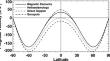
for different tracking rates (i.e., different latitudes). As shown in Figure 68
, it is remarkable
that the inferred rotation
and meridional circulation
are both similar to that of the
small magnetic features (Komm et al., 1993b,c). This property is consistent with the view that
magnetic fields are advected by supergranular flows. In addition, the torsional oscillations are seen
with the same phase and amplitude as in global helioseismology. The temporal changes in the
meridional circulations are also consistent with an inflows toward the mean latitude of activity (see
Section 5.3.4).
|
|
The lifetime of supergranules is about
at
, i.e., a somewhat larger value than other
estimates derived from the decay of the autocorrelation function. This is because the lifetime is not strictly
given the decay of the correlation function at short time lags, but by the decay of the envelope of the
correlation function, which oscillates. The lifetime decreases by about 20% at active latitudes (Gizon and
Duvall Jr, 2004).
As mentioned earlier, estimates of supergranulation rotation obtained by tracking the Doppler pattern
are systematically found to be higher than the rotation of the magnetic network (for large
time lags, see panel (a) of Figure 63
). This apparent superrotation of the pattern can now be
understood as the result of the waves being predominantly prograde. The east-west motion of the
pattern is effectively a power-weighted average of the true rotation and the non-advective phase
speed
for
. Similarly, the excess of wave power toward the
equator is reflected in the equatorward meridional motion of the pattern at large time lags
(see panel (b) of Figure 63
) even though the advective flow is poleward. Correlation tracking
measurements must take into account the fact that the pattern propagates like a modulated traveling
wave.
The measurement of the pattern rotation obtained by Lisle et al. (2004
) is also a direct
consequence of the power spectrum. It is straightforward to show that the ratio
(see
Section 5.3.4) can be expressed in terms of
alone. Plugging in Equations (95
, 96
, 97
),
one finds that at the equator the variations of
as a function of tracking velocity
should display two peaks at
, where
is the dominant wave speed
and
is the advective velocity. The amplitudes of the peaks are approximately given by
It was a source of concern that the wavelike properties of supergranulation had not been seen previously
in surface Doppler shifts. Schou (2003b
) showed that the same phenomenon can be observed directly using
MDI Dopplergrams, thereby confirming the observations of Gizon and Duvall Jr (2003). In addition to
confirming those results, Schou (2003b) was able to extend the measurements f