5.1 Global scales
Flows in the upper convection zone have been measured by local helioseismology on a wide
variety of scales, including differential rotation and meridional circulation, local flows around
complexes of magnetic activity and sunspots, and convective flows. Here we mostly discuss the
longitudinal averages of flows measured by local helioseismology, and their solar-cycle variations. The
focus is on temporal variations that are slow compared to the typical lifetime of active regions.
By computing longitudinal averages of rotation and meridional circulation over a few solar
rotation periods it is possible to filter out small-scale flows and to reach a sensitivity of the
order of
near the surface. The evolution of flows through cycle 23 reveals connections
between mass motions in the solar interior and the large-scale characteristics of the magnetic
cycle.
5.1.1 Rotation and torsional oscillations
Measuring the mean rotation using local techniques is a useful exercise, in particular to compare with
estimates from inversions of frequency-splitting coefficients. Giles et al. (1998
) and Giles (1999
) measured
rotation with time-distance helioseismology applied to MDI data (structure and dynamics programs;
see Scherrer et al., 1995
). Figure 30 shows the angular velocity as a function of latitude for radii
. There is a good qualitative agreement between the time-distance and the global-mode
inversions, although the agreement is not as good at high latitudes. Basu et al. (1998, 1999
) used the
ring-diagram method to obtain the rotational velocity for
in the latitude range
.
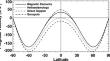
The north-south symmetric component of rotation compares favorably with the rotation determined
from the frequency splittings of the global p modes (Figure 31). Since the inversion results
of p-mode splittings were not expected to be particularly reliable near the surface, the ring
diagram results complement and support the earlier conclusion that rotation increases with depth,
near the surface, at low latitudes. Possible explanations for the existence of this near-surface
radial shear have been discussed by Gilman (2000
) and Robinson and Chan (2001). The local
helioseismology results also show measurable differences in the rotation profile between the northern
and southern hemispheres (see, e.g., Basu et al., 1999
; Giles, 1999
; González Hernández
and Patrón, 2000). It would be premature, however, to trust the validity of the north-south
asymmetry in the rotation rate, since systematic errors are not fully understood and do vary with
latitude.
Howard and Labonte (1980) discovered small (
) latitudinal variations in the surface
Doppler rotation profile that propagate toward the equator with the sunspot latitudes. These variations,
known as torsional oscillations, have since been confirmed by global helioseismology (Kosovichev and
Schou, 1997; Schou, 1999). Inversions of global-mode frequency splittings have shown that torsional
oscillations persist at a depth over a large fraction of the convection zone (Howe et al., 2000a), especially
at high latitudes where they extend down to the bottom of the convection zone (Vorontsov
et al., 2002
). At low latitudes, the data support the idea that the torsional oscillation pattern
originates inside the convection zone and propagates both upward and equatorward (Vorontsov
et al., 2002
; Basu and Antia, 2003
). Above
latitude, bands of faster and slower rotation appear to
move toward the poles (Antia and Basu, 2001; Schou, 2003a) suggesting a connection with the
poleward migration of high-latitude magnetic activity seen at the surface (see, e.g., Callebaut and
Makarov, 1992).
Both time-distance (Giles et al., 1998; Beck et al., 2002
; Zhao and Kosovichev, 2004
) and
ring-diagram (Basu et al., 1999
; Basu and Antia, 2000; Haber et al., 2000
, 2002
) analyses have confirmed
the global-mode measurements of torsional oscillations. Figure 32 shows a plot of the zonal flows at depths
of
and
obtained from ring-diagram analysis. At both these depths, propagating zonal
fast bands are seen to migrate toward the equator as the solar cycle progresses. As will be later discussed in
Section 5.2, local techniques can also provide information about the longitudinal structure of the zonal
flows.
Schüssler (1981) and Yoshimura (1981) suggested that the torsional oscillations may be driven by the
Lorentz force due to a migrating dynamo wave. Recent numerical calculations by Covas et al. (2000) seem
to be consistent with this hypothesis; their calculations also reproduce the poleward propagating torsional
oscillations at high latitudes. Other explanations attribute the torsional oscillations to the feedback of the
smaller-scale magnetic fields on the angular momentum transport mechanisms responsible for differential
rotation, e.g., changes in the Reynolds/Maxwell stresses (Küker et al., 1996; Kitchatinov
et al., 1999) or the local suppression of turbulent viscosity by active regions (Petrovay and
Forgács-Dajka, 2002). An alternative explanation by Spruit (2003
) suggests that zonal flows may be
driven by temperature perturbations near the surface due to the magnetic field: Local flows
around regions of enhanced magnetic activity act through the Coriolis force to balance horizontal
pressure gradients. The model of Spruit (2003
) naturally predicts a solar-cycle variation in the
meridional flows. The reader is referred to the review paper of Shibahashi (2004) for other possible
explanations.
5.1.2 Meridional flow and its variations
Surface Doppler measurements have shown the existence of a meridional flow from the equator to the poles
with an amplitude of about
(e.g. Hathaway, 1996). Meridional circulation is an important
ingredient of solar dynamo models where magnetic flux is transported by a deep equatorward flow
(flux-transport dynamo models). In such models, the solar-cycle period is largely determined by the
amplitude of the meridional flow near the base of the convection zone (Dikpati and Charbonneau, 1999).
Hathaway et al. (2003) claimed that the butterfly diagram is evidence for flux-transport dynamo models,
and estimated a
flow at the bottom of the convection zone from the drift of sunspots
toward the equator. However, Schüssler and Schmitt (2004) argue that the butterfly diagram is
equally well reproduced by a conventional dynamo model with migrating dynamo waves without
transport of magnetic flux by a flow. The depth of penetration of the meridional flow is another
parameter in some dynamo models (see, e.g., Nandy and Choudhuri, 2002). Knowing meridional
circulation is also important to understand its feedback on differential rotation (Rekowski and
Rüdiger, 1998; Gilman, 2000).
Meridional circulation was first detected at depth by Giles et al. (1997) with time-distance
helioseismology. The inversions, constrained by mass conservation, show that the data are consistent with a
meridional circulation which is
poleward at the solar surface and about
equatorward
at the base of the convection zone, with a turnover point near
(Giles, 1999
, see Figure 33). Other
estimates of the meridional circulation have been obtained in the near-surface layers with time-distance
helioseismology (see, e.g., Duvall Jr and Gizon, 2000
; Zhao and Kosovichev, 2004
), Hankel analysis
(Braun and Fan, 1998
), acoustic imaging (e.g. Chou and Dai, 2001
), and ring-diagram analysis (see,
e.g., Basu et al., 1999; González Hernández et al., 1999, 2000; Haber et al., 2000). Giles (1999
) and
Haber et al. (2002) found a submerged equatorward flow in the north during the years 1998-2001.
This last result, however, may be contaminated in part by errors in the orientation of the MDI
Dopplergrams which cause rotation to leak into the meridional flow signal: a
-angle error due to the
misalignement of the MDI telescope on the SOHO spacecraft (C. Toner, 2000, private communication)
and an error in the Carrington elements that specify the direction of the solar rotation axis
(Giles, 1999
).
Meridional circulation (averaged in longitude over several rotation periods) is observed to change from
year to year through the solar cycle. To study the time-varying component of meridional circulation, we
consider the residuals obtained after subtraction of a temporal average at each latitude. Meridional flow
residuals have an amplitude which is less than
. Like torsional oscillations, the north-south flow
residuals drift equatorward with active latitudes. Unlike torsional oscillations, the residuals of meridional
circulation change sign across the uppermost
. Near the surface, the time-varying residuals
converge toward active latitudes (Gizon, 2003
; Basu and Antia, 2003; Zhao and Kosovichev, 2004
, see
Figure 34), while at greater depths meridional flow residuals diverge from the dominant latitude of activity
(Chou and Dai, 2001; Beck et al., 2002
, see Figure 35). The time-varying component of meridional
circulation has also been measured near the surface from the advection of supergranulation (Gizon and
Duvall Jr, 2004
, see Section 5.3.5).
These observations, summarized in Figure 36, lead Zhao and Kosovichev (2004
) to postulate the
existence of extra meridional ciculation rolls on each side of the mean latitude of activity, superimposed on
the mean global-scale poleward flows. However, it is suggested in Section 5.2 that the changes in the
longitudinal averages of meridional flows can be attributed for a large part to flows that are localized both
in longitude and latitude around active regions.
5.1.3 Vertical flows
Because of their small amplitude, vertical flows are much harder to measure than horizontal flows. The
ring-diagram analysis is not, in principle, sensitive to vertical flows. However, Komm et al. (2004
) showed
how to estimate the vertical flows from ring-diagram inversions by adding a mass conservation constraint
(using GONG data). This mass conservation constraint is enforced locally for each
region,
under the assumption is that horizontal density fluctuations are negligible because of the large size of the
region and the large integration time. Figure 37 shows the longitudinal average of the near-surface vertical
velocity over one Carrington rotation (Komm et al., 2004
). Weak downflows (less than
) are
observed near active latitudes. This result is consistent with the observations of a residual horizontal flow
converging toward the mean latitude of activity near the surface (see Figure 36). For depths in the range
, the amplitude of the downflow increases with depth. A small upflow is seen near the
equator.
5.1.4 Search for variability at the tachocline
Howe et al. (2000b
) discovered temporal changes in the rotational velocity near the bottom of the
convection zone with a period of approximately
and a peak amplitude at
. The angular
velocity variations at
and
are anticorrelated (the signal seemed much weaker near the
second half of 2001 but it has come back since). These results are somewhat controversial since they have
not been confirmed by others (see, e.g., Basu and Antia, 2001; Vorontsov et al., 2002). However,
using wavelet analysis over cycles 21-23, Boberg et al. (2002) found signals with a 1-2
period in the solar mean magnetic field and Knaack et al. (2005) detected transient
oscillations in the unsigned photospheric magnetic flux, which may be related to the large-scale
magnetic surges towards the poles. The
periodicity is also seen in observations of the
interplanetary magnetic field and geomagnetic activity (Lockwood, 2001). Gough (2000) suggested
that a
radial magnetic field across the tachocline may lead to exchange of angular
momentum with the right time scale, while Covas et al. (2001) suggested a highly non-linear
mechanism that does not require different physical time scales for torsional and tachocline
oscillations.
A deeply challenging task for local helioseismology is to detect the signature of the magnetic field in the
tachocline region. The results of Howe et al. (2000b) have not been confirmed by local helioseismology yet,
but there have been a few attempts to search for wave-speed perturbations near the base of the convection
zone. Chou and Serebryanskiy (2002
) selected wave packets that return to the same spatial point after
traveling around the Sun with an integral number of bounces
. The ray paths taking
bounces to go around the Sun have a lower turning point close to the bottom of the convection
zone. Chou and Serebryanskiy (2002
) observed that the change in one-bounce travel time at
solar maximum relative to minimum is approximately the same for all
values studied,
except for
which shows an additional decrease in travel time. Figure 38 shows the
relative decrease in the one-bounce travel time at
relative to the other
values as a
function of time (about
at solar maximum). The correlation with the sunspot number
suggests that the additional decrease in travel time at
might be caused by wave-speed
perturbations at the base of the convection zone. With the simplified assumption that this
additional decrease is caused only by a magnetic field perturbation at the base of the convection
zone, the field strength was estimated to be
at solar maximum. However, Chou and
Serebryanskiy (2002
) caution that this interpretation is oversimplified since it would also imply an
additional decrease in travel time for the wave packets with
, which is not observed. We
note here that Ruzmaikin and Lindsey (2003) argue that only field strengths greater than
should be detectable near the bottom of the convection zone with currently available
data.
A different approach by Birch (2002) and Duvall Jr (2003
) was to search for longitudinal structures
near the bottom of the convection zone. Raw travel times measured between surface points
separated by
were observed to be correlated from day to day, indicating a real solar signal
(Duvall Jr, 2003). However, it is not known whether this signal is due to surface effects or deep
perturbations.
It should be mentioned that global seismology may also be used to detect a toroidal magnetic field at
the level of a fraction of a megagauss, if such a field were confined to a thin layer near the base of the
convective envelope (e.g., Basu, 1997
; Dziembowski and Goode, 2004). For example, Basu (1997) gave an
upper limit of
near solar minimum.
It is fair to say that local helioseismological techniques have encountered difficulties in probing the
tachocline. In order to reach a depth of
, it is necessary to consider ray paths that connect surface
points separated by almost
. All local methods thus suffer from foreshortening near the limb. Also, the
plane-wave approximation is obviously not appropriate for probing the deep convection zone. Certain
methods, like ring-diagram analysis, need to be adapted to take this into account (see, e.g., Haber
et al., 1995).