7.6 Intermittency properties recovered via a shell model
The FSGC shell model has remarkable properties which closely resemble those typical of MHD
phenomena (Giuliani and Carbone, 1998
). However, the presence of a constant forcing term always induces
a dynamical alignment, unless the model is forced appropriately, which invariably brings the system towards
a state in which velocity and magnetic fields are strongly correlated, that is, where
and
. When we want to compare statistical properties of turbulence described by MHD shell
models with solar wind observations, this term should be avoided. It is possible to replace the
constant forcing term by an exponentially time-correlated Gaussian random forcing which is
able to destabilize the Alfvénic fixed point of the model (Giuliani and Carbone, 1998
), thus
assuring the energy cascade. The forcing is obtained by solving the following Langevin equation:
where
is a Gaussian stochastic process
-correlated in time
. This kind
of forcing will be used to investigate statistical properties.
A statistically stationary state is reached by the system, as shown in Giuliani and Carbone (1998), with
a well defined inertial range, say a region where Equation (29) is verified. Spectra for both the
velocity
and magnetic
variables, as a function of
, obtained in the
stationary state, are shown in Figures 79 and 80. Fluctuations are averaged over time. The
Kolmogorov spectrum is also reported as a solid line. It is worthwhile to remark that, by adding
a random term like
to a little modified version of the MHD GOY shell model
(
is a random function with some statistical characteristics), a Kraichnan spectrum, say
, where
is the total energy, can be recovered (Hattori and Ishizawa, 2001). The
term added to the model could represent the effect of the occurrence of a large-scale magnetic
field.
Intermittency in the shell model is due to the time behavior of shell variables. It has been shown
(Okkels, 1997
) that the evolution of GOY model consists of short bursts traveling through
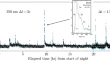
the shells and long period of oscillations before the next burst arises. In Figures 81 and 82
we report the time evolution of the real part of both velocity variables
and magnetic
variables
at three different shells. It can be seen that, while at smaller
variables seems
to be Gaussian, at larger
variables present very sharp fluctuations in between very low
fluctuations.
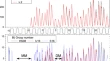
The time behavior of variables at different shells changes the statistics of fluctuations. In Figure 83 we
report the probability density functions
and
, for different shells
, of standardized
variables
where
indicates that we take the real part of
and
. Typically we see that PDFs look
differently at different shells: At small
fluctuations are quite Gaussian distributed, while
at large
they tend to become increasingly non-Gaussian, by developing fat tails. Rare
fluctuations have a probability of occurrence larger than a Gaussian distribution. This is the
typical behavior of intermittency as observed in usual fluid flows and described in previous
sections.
The same phenomenon gives rise to the departure of scaling laws of structure functions from a
Kolmogorov scaling. Within the framework of the shell model the analogous of structure functions are
defined as
For MHD turbulence it is also useful to report mixed correlators of the flux variables, i.e.,
Scaling exponents have been determined from a least square fit in the inertial range
. The
values of these exponents are reported in Table 4. It is interesting to notice that, while scaling exponents for
velocity are the same as those found in the solar wind, scaling exponents for the magnetic field found in the
solar wind reveal a more intermittent character. Moreover, we notice that velocity, magnetic and
Elsässer variables are more intermittent than the mixed correlators and we think that this could
be due to the cancellation effects among the different terms defining the mixed correlators.
| Table 4: |
Scaling exponents for velocity and magnetic variables, Elsässer variables, and fluxes.
Errors on are about one order of magnitude smaller than the errors shown. |
|
Time intermittency in the shell model generates rare and intense events. These events are the result of
the chaotic dynamics in the phase-space typical of the shell model (Okkels, 1997). That dynamics is
characterized by a certain amount of memory, as can be seen through the statistics of waiting times between
these events. The distributions
of waiting times is reported in the bottom panels of Figures 83, at a
given shell
. The same statistical law is observed for the bursts of total dissipation (Boffetta
et al., 1999).