7.1 Propagating fast waves in coronal loops
Wave lengths of propagating waves should be much
shorter than the size of the structure guiding the wave. The shorter wave lengths correspond to shorter
periods of the waves, requiring high cadence observational tools. In particular, the typical cadence time of
TRACE and EIT EUV imagers is
, which gives the minimal period of detected waves to be about
. For a typical coronal Alfvén speed of about
, at least, this corresponds to
wavelengths longer than
, which is comparable with the typical size of a coronal loop. Thus,
the EUV imagers cannot normally be used for the detection of propagating fast waves guided by coronal
loops. On the other hand, time resolution of a second or better can be achieved with ground based
coronographs or radioheliographs.
Recently, Williams et al. (2001
, 2002
) and Katsiyannis et al. (2003
) reported the observational
discovery of rapidly propagating compressible wave trains in coronal loops with the SECIS instrument
during a full solar eclipse. As the observed speed was estimated at about
, these waves were
interpreted as fast magnetoacoustic modes. The waves were observed to have a quasi-periodic pattern with
a mean period of about
. Cooper et al. (2003
) found an encouraging agreement between the observed
evolution of the wave amplitude along the loop with the theoretical prediction made for kink and
sausage modes (see Figure 20). Unfortunately, the high uncertainty in the measurement of the
amplitude does not allow the authors to distinguish between the kink and sausage modes in this
observation.
The main difference of these works from a number of previous papers analysing eclipse observations is
the application of the methods of the time-distance (stroboscopic) plot (Williams et al., 2001, 2002)
and of the wavelet transform (Katsiyannis et al., 2003
). Those techniques are certainly more
preferable in the situation when the waves have modulation or form wave trains. According to
dispersion relation (7), fast waves are highly dispersive when their wave length is comparable or
longer than the radius of the loop. It is well known that, in a dispersive medium, impulsively
generated (or broadband because of another reason) waves evolve into a quasi-periodic wave train
with a pronounced period modulation. In the coronal context, it was pointed out by Edwin
and Roberts (1983) and Roberts et al. (1983, 1984
) that periodicity of fast magnetoacoustic
modes in coronal loops is not necessarily connected with the wave source, but can be created by
the dispersive evolution of an impulsively generated signal. Studying the dispersive evolution,
Roberts et al. (1984
) analytically predicted that the development of the propagating sausage
pulse forms a characteristic quasi-periodic wave train with three distinct phases. Such evolution
scenario is determined by the presence of minimum in the group speed dependence upon the wave
number. That analysis was restricted to the case of the slab with sharp boundaries and to sausage
modes only. The initial stage of the pulse evolution was numerically modelled by Murawski and
Roberts (1993, 1994), Murawski et al. (1998), and was found to be consistent with the analytical
prediction.
Nakariakov and Roberts (1995b) studied the case of a smooth density profile of a zero plasma-
plasma,
(cf. Equation (19) and Figure 8). The power index
determines the steepness of the profile. The cases
when the power index
equals to either unity or infinity correspond to the symmetric Epstein profile or
to the step function profile, respectively, both with known analytical solutions in the eigenvalue problem.
The group speed has a minimum for all profiles with the power index greater than unity, which are steeper
than the symmetric Epstein profile. Thus, the steepness of the profile affects the shape of the
wave train and, consequently, the analysis of wave trains can give us information about this
profile.
Nakariakov et al. (2004a
) numerically simulated the developed stage of the dispersive evolution of
a fast wave train in a smooth straight slab of a low plasma-
plasma. It was found that
development of an impulsively generated pulse leads to formation of a quasi-periodic wave train
with the mean wavelength comparable with the slab width. In agreement with the analytical
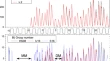
theory (Roberts et al., 1984), the wave train has a pronounced period modulation which was
demonstrated with the wavelet transform technique (see Figure 21). In particular, it is found that the
dispersive evolution of fast wave trains leads to the appearance of characteristic “tadpole” wavelet
signatures. Similar signatures were found in the wavelet analysis of SECIS data (Katsiyannis
et al., 2003), strengthening the interpretation of the SECIS waves as the fast magnetoacoustic wave
trains.
This mechanism may also be responsible for the formation of quasi-periodic pulsations with the periods
of about a second, observed in association with flares. However, the main property of this effect, which must
be taken into account in interpretation, is the period modulation.