6.2 Theoretical modelling
Theoretical models of the propagation of longitudinal waves in stratified
coronal structures, such as polar plumes (Ofman et al., 1999
, 2000a
) and coronal loops (Nakariakov
et al., 2000), describe the evolution of the wave shape and amplitude with the distance along the structure
in terms of the extended Burgers equation
where the coefficients
,
, and
are, in general, functions of
and describe:
- the effects
of stratification, radiative losses, and heating;
- dissipation by thermal conductivity and viscosity;
- nonlinearity. The
is the running coordinate. When
, Equation (52) reduces to the
Burgers equation. Specific expressions for the coefficients depend upon the geometry of the problem and are
different in the plume and loop cases.
Let us illustrate the derivation of Equation (52) in a specific situation. Following Tsiklauri and
Nakariakov (2001
), we consider a semi-circular loop of the curvature radius
, with the inclination
angle
(measured from the normal to the solar surface) and a non-zero offset of circular
loop centre from the coronal base line,
(i.e., distance from the circle’s centre to the solar
surface). The loop cross-section is taken to be constant. The loop is filled with a gravitationally
stratified magnetised plasma of constant temperature. The sketch of the model is shown in
Figure 16.
The gravitational acceleration along the loop is
where
,
, and
. The use of the hydrostatic
equilibrium equations and the isothermal equation of state, allows us to write the stationary density profile
along the loop as
Assuming that the wavelength is much less than the scale height, the dissipation and the nonlinearity
lengths, and applying the multi-scale expansion method, we obtain the evolutionary equation for
weakly nonlinear, weakly dissipative slow magnetoacoustic waves in stratified coronal loops,
where an effective scale height is introduced as
,
is the coefficient of thermal
conduction, and
denotes the volume viscosity or thermal conductivity.
Similarly, in the radially stratified vertical polar plume, the evolutionary equation is
where
is the radial (or vertical) coordinate (see Ofman et al., 2000a
, for details; both the viscosity and
thermal conduction are included in the dissipative coefficient
).
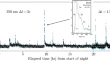
Solutions of Equation (52) are in a satisfactory agreement with the observed evolution of the
wave amplitude: For example, Figure 17 demonstrates the comparison of the observed and
theoretically predicted growth of the longitudinal wave amplitude with height. Also, full MHD 2D
numerical modelling of these waves gives similar results (see Ofman et al., 1999
, 2000a). The
comparison of the observed and modelled evolution scenarios give the possibility of estimating, in
particular, the efficiency of non-adiabatic processes, such as the competition of heating and radiative
losses.
The energy carried and deposited by the observed waves is certainly insufficient for heating of the loop.
However, Tsiklauri and Nakariakov (2001) have shown that sufficiently broadband slow magnetoacoustic
waves, consistent with currently available observations in the low frequency part of the spectrum, can
provide the rate of heat deposition sufficient to heat the loop. In this scenario, the heat would be deposited
near the loop footpoints which agrees with observationally determined positioning of the heat
source.