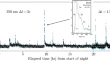
DeForest and Gurman (1998), using EIT 171 Å data confirmed this discovery: Outwardly propagating
perturbations of the intensity were observed at distances of
, gathered in quasi-periodic
groups of
periods, with periods of about
, The projected speeds are about
and the relative amplitude (in density) was about
.
A similar phenomenon was observed near the footpoints of coronal loops, with EIT (Berghmans and
Clette, 1999) and TRACE (Nightingale et al., 1999; De Moortel et al., 2000, 2002a
,b) imagers as
near-isothermal EUV intensity disturbances, which start near the loop footpoints and propagate along the
loops at the apparent speed lower than the sound speed. Multi-wavelength observations have been
performed by Robbrecht et al. (2001
) combining TRACE 171 Å and EIT 195 Å and by King et al. (2003
)
with TRACE 171 Å and 195 Å. Robbrecht et al. (2001
) found the projected propagation speeds to vary
roughly between
and
for both instruments, which is close to and below the expected
sound speed in the coronal loops, respectively. King et al. (2003
) pointed out the high correlation of the
disturbances observed in the different bandpasses. Also, recently, a coordinated observation of this
phenomenon with SOHO/CDS and TRACE instruments has been carried out Marsh et al. (2003). A
propagating oscillation with a period of about
, observed by TRACE in the 171 Å bandpass,
was also observed in He I, O V and Mg IX emission lines with CDS, corresponding to the
chromospheric, transition region, and coronal temperatures, respectively. This is consistent
with about
oscillations observed by O’Shea et al. (2001) with CDS in both velocity
and intensity time series associated with the coronal lines Mg IX and Fe XVI, as well as in
O V.
A comprehensive overview of observational properties of the longitudinal oscillations, based upon the
analysis of
examples, is given in De Moortel et al. (2002a), and a more recent one in
Nakariakov (2003). The properties of propagating EUV disturbances may be summarised as follows: the
projected propagation speed is
; the amplitudes are always less than
in intensity
(less than
in density); the disturbances are quasi-periodic with the periods about
. In
most cases, only upwards propagating disturbances have been detected (from the footpoints to the apex of
the loop). Sometimes, the waves can be present for several consecutive hours with, more or less,
constant period. It is possible that the disturbances with shorter, about
, periods are
situated above sunspot regions, whereas disturbances propagating along the loops which are not
associated with sunspots have longer periodicity, of about
(De Moortel et al., 2002c).
However, King et al. (2003
) showed that both
and
perturbations can coexist
in the same coronal structure, at least in the analysed example, so the question still remains
open.
The propagation direction and speed, together with the fact that the observed waves are compressible
suggest their interpretation as slow magnetoacoustic waves. Slow waves of the observed periodicities
(shorter than
) can propagate without reflection in the
corona, as the
acoustic cut-off period is about
. According to this interpretation, the waves propagate at
about the sound speed in the loop. The observed speed of the waves is reduced by line-of-sight
projection.
Waves were also recently detected in the Doppler velocity data in the
and
ranges by Sakurai et al. (2002). The line intensity and line width did not show clear oscillations, but
their phase relationship with the Doppler velocity indicates propagating waves rather than
standing waves. These waves were interpreted as superposition of propagating slow and Alfvén
waves.
| http://www.livingreviews.org/lrsp-2005-3 |
© Max Planck Society and the author(s)
Problems/comments to |