 |
Figure 1:
Parker’s view of cyclonic turbulence twisting a toroidal magnetic field (here ribbons
pointing in direction ) into meridional planes (reproduced from Figure 1 of Parker, 1955). |
 |
Figure 2:
The Babcock-Leighton mechanism of poloidal field production from the decay of bipolar
active regions showing opposite polarity patterns in each solar hemisphere (reproduced from Figure 8
of Babcock, 1961). |
 |
Figure 3:
The sunspot “butterfly diagram”, showing the fractional coverage of sunspots as a function
of solar latitude and time (courtesy of D. Hathaway). |
 |
Figure 4:
Synoptic magnetogram of the radial component of the solar surface magnetic field.
The low-latitude component is associated with sunspots. Note the polarity reversal of the weaker,
high-latitude magnetic field, occurring approximately at time of sunspot maximum (courtesy of
D. Hathaway). |
 |
Figure 5:
Isocontours of angular velocity generated by Equation (17), with parameter values
, , , (Panel A). The radial shear changes
sign at colatitude . Panel B shows the corresponding angular velocity gradients, together
with the total magnetic diffusivity profile defined by Equation (19) (dash-dotted line). The
core-envelope interface is located at (dotted lines). |
 |
Figure 6:
Radial variations of the -effect for the two classes of mean-field models considered
in Section 4.2.5. The magnetic diffusivity profile is again indicated by a dash-dotted line, and the
core-envelope interface by a dotted line. |
 |
Figure 7:
Northern hemisphere time-latitude (“butterfly”) diagrams for a selection of dynamo
solutions, constructed at the depth corresponding to the core-envelope interface.
Isocontours of toroidal field are normalized to their peak amplitudes, and plotted for increments
, with yellow-to-red (green-to-blue) contours corresponding to ( ).
All but the first solution have the -effect concentrated at the base of the envelope, with a latitude
dependence as given above each panel. Other model ingredients as in Figure 5. Note the co-existence
of two distinct, cycles in the solution shown in Panel B. Four corresponding animations are available
in Resource 1. |
 |
Figure 8:
Time series of magnetic energy in four mean-field dynamo solutions. Panels A
and B show the time series associated with the solutions shown in Panels B and D of Figure 7 (base
CZ, , ). Note the initial phase of exponential growth of the magnetic
field, followed by a saturation phase characterized here by an (atypical) periodic modulation in the
case of the solution in Panel A. Panels C and D show time series for two interface dynamo solutions
(see Section 4.3 and Figure 10) for two diffusivity ratios. The energy scale is expressed in arbitrary
units, but is consistent across all four panels. |
 |
Figure 9:
Three interface dynamo models in semi-infinite Cartesian geometry. In Parker’s original
model, the -effect occupies the space and the radial shear , with the magnetic
diffusivity varying discontinuously from (low) to (high) across the surface. The
MacGregor and Charbonneau model is similar, except that the shear and -effect are spatially
localized as -functions, located a finite distance away from in their respective halves
of the domain. The Zhang et al. model moves one step closer to the Sun by truncating vertically
the Parker model, and sandwiching the dynamo layers between a vacuum layer (top) and very low
diffusivity layer (bottom); this bottom layer represents the radiative core, while the shear region is
then associated with the tachocline. Each one of these models supports travelling waves solutions of
the form , vertically localized about the core-envelope interface ( ). |
 |
Figure 10:
A representative interface dynamo model in spherical geometry. This solution has
, , and a core-to-envelope diffusivity contrast of . Panel A shows
a sunspot butterfly diagram, and Panel B a series of radial cuts of the toroidal field at latitude
. The (normalized) radial profiles of magnetic diffusivity, -effect, and radial shear are also
shown, again at latitude . The core-envelope interface is again at (dotted line),
where the magnetic diffusivity varies near-discontinuously. Panels C and D show the variations of
the core-to-envelope peak toroidal field strength and dynamo period with the diffusivity contrast,
for a sequence of otherwise identical dynamo solutions. Corresponding animations are available in
Resource 2. |
 |
Figure 11:
Streamlines of meridional circulation (Panel A), together with the total magnetic
diffusivity profile defined by Equation (19) (dash-dotted line) and a mid-latitude radial cut of
(bottom panel). The dotted line is the core-envelope interface. This is the analytic flow of van
Ballegooijen and Choudhuri (1988), with parameter values , , , and
. |
 |
Figure 12:
Time-latitude diagrams for three of the solutions depicted earlier in Panels B
to D of Figure 7, except that meridional circulation is now included, with (top row),
(middle row), and (bottom row). For the turbulent diffusivity value
adopted here, , corresponds to a solar-like circulation speed.
Corresponding animations are available in Resource 3. |
 |
Figure 13:
Time-latitude diagrams of the surface radial magnetic field, for increasing values of
the circulation speed, as measured by the Reynolds number . This is an solution
with the -effect concentrated at low-latitude and at the base of the convective envelope (see
Section 4.2.5 and Panel B of Figure 7). Recall that the solution in Panel A exhibits
amplitude modulation (cf. Panel B of Figure 7 and Panel A of Figure 8). |
 |
Figure 14:
A sample of longitudinally-averaged kinetic helicity profiles associated with the linearly
unstable horizontal planforms of azimuthal order (as indicated) in the shallow-water model
of Dikpati and Gilman (2001). The parameters and control the form of the latitudinal
differential rotation, and are equivalent to the parameters and in Equation (18) herein. The
parameter is a measure of stratification in the shallow-water model, with larger values of
corresponding to stronger stratification (and thus a stronger restoring buoyancy force); is
equivalent to a subadiabaticity of (diagram kindly provided by M. Dikpati). |
 |
Figure 15:
Time-latitude “butterfly” diagrams of the toroidal field at the core-envelope interface
(left), and surface radial field (right) for a representative dynamo solution computed using the model
of Dikpati and Gilman (2001). Note how the deep toroidal field peaks at very low latitudes, in good
agreement with the sunspot butterfly diagram. For this solution the equatorial deep toroidal field
and polar surface radial field lag each other by , but other parameter settings can bring this
lag closer to the observed (diagrams kindly provided by M. Dikpati). |
 |
Figure 16:
Stability diagram for toroidal magnetic flux tubes located in the overshoot layer
immediately beneath the core-envelope interface. The plot shows contours of growth rates in the
latitude-field strength plane. The gray scale encodes the azimuthal wavenumber of the mode with
largest growth rate, and regions left in white are stable. Dynamo action is associated with the regions
with growth rates , here labeled I and II (diagram kindly provided by A. Ferriz-Mas). |
 |
Figure 17:
Operation of a solar cycle model based on the Babcock-Leighton mechanism. The diagram
is drawn in a meridional quadrant of the Sun, with streamlines of meridional circulation plotted in
blue. Poloidal field having accumulated in the surface polar regions (“A”) at cycle must first
be advected down to the core-envelope interface (dotted line) before production of the toroidal field
for cycle can take place (B C). Buoyant rise of flux rope to the surface (C D) is a
process taking place on a much shorter timescale. |
 |
Figure 18:
Time-latitude diagrams of the surface toroidal field at the core-envelope interface
(Panel A), and radial component of the surface magnetic field (Panel B) in a Babcock-Leighton
model of the solar cycle. This solution is computed for solar-like differential rotation and meridional
circulation, the latter here closing at the core-envelope interface. The core-to-envelope contrast in
magnetic diffusivity is , the envelope diffusivity , and the
(poleward) mid-latitude surface meridional flow speed is . |
 |
Figure 19:
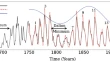
Fluctuations of the solar cycle, as measured by the sunspot number. Panel A is a time
series of the Zürich monthly sunspot number (with a 13-month running mean in red). Cycles are
numbered after the convention introduced in the mid-nineteenth century by Rudolf Wolf. Note how
cycles vary significantly in both amplitude and duration. Panel B is a portion of the time
series spanning the Maunder Minimum (data courtesy of J. Beer). Panel C shows a time series of
the yearly group sunspot number of Hoyt and Schatten (1998) (see also Hathaway et al., 2002)
over the same time interval, together with the yearly Zürich sunspot number (purple) and auroral
counts (green). Panels D and E illustrate the pronounced anticorrelation between cycle amplitude
and rise time (Waldmeier Rule), and alternance of higher-than-average and lower-that-average cycle
amplitudes (Gnevyshev-Ohl Rule, sometimes also referred to as the “odd-even effect”). |
 |
Figure 20:
Amplitude and parity modulation in a dynamo model including magnetic backreaction
on the differential rotation. These are the usual time-latitude diagrams for the toroidal magnetic
field, now covering both solar hemispheres, and exemplify the two basic types of modulation arising
in nonlinear dynamo models with backreaction on the differential rotation (see text; figure kindly
provided by S.M. Tobias). |
 |
Figure 21:
Two bifurcation diagrams for a kinematic Babcock-Leighton model, where amplitude
fluctuations are produced by time-delay feedback. The top diagram is computed using the
one-dimensional iterative map given by Equations (40, 41), while the bottom diagram is
reconstructed from numerical solutions in spherical geometry, of the type discussed in Section 4.8.
The shaded area in Panel A maps the attraction basin for the cyclic solutions, with initial conditions
located outside of this basin converging to the trivial solution . |
 |
Figure 22:
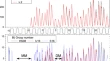
Stochastic fluctuations of the dynamo number in an mean-field dynamo solution.
The reference, unperturbed solution is the same as that plotted in Panel D of Figure 7, except that
is uses a lower value for the dynamo number, . Panel A shows magnetic energy time series
for three solutions with increasing fluctuation amplitudes, while Panel B shows a correlation plot of
cycle amplitude and duration, as extracted from a time series of the toroidal field at the core-envelope
interface ( ) in the model. Solutions are color-coded according to the relative amplitude
of the fluctuations in the dynamo number. Line segments in Panel B indicate the mean
cycle amplitudes and durations for the three solutions. The correlation time of the noise amounts
here to about 5% of the mean half-cycle period in all cases. |
 |
Figure 23:
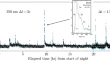
Intermittency in a dynamo model based on flux tube instabilities (cf. Sections 3.2.3
and 4.7). The top panel shows a trace of the toroidal field, and the bottom panel is a butterfly
diagram covering a shorter time span including a quiescent phase at , and a “failed
minimum” at (figure produced from numerical data kindly provided by M. Ossendrijver). |
 |
Figure 24:
Intermittency in a dynamo model based on the Babcock-Leighton mechanism
(cf. Sections 3.2.4 and 4.8). The top panel shows a trace of the toroidal field sampled at
. The bottom panel is a time-latitude diagram for the toroidal field at the
core-envelope interface (numerical data from Charbonneau et al. (2004)). |