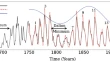
At any rate, the notion of a nicely regular 11/22-year cycle does not hold long upon even cursory
scrutiny, as the amplitude of successive cycles is clearly not constant, and their overall shape often differs
significantly from one cycle to another (cf. cycles 14 and 15 in Panel A of Figure 19
). Closer
examination of Figure 19
also reveals that even the cycle’s duration is not uniform, spanning in fact a
range going from
(cycle 2) to nearly
(cycle 4). These amplitude and duration
variations are not a sunspot-specific artefact; similar variations are in fact observed in other activity
proxies with extended records, most notably the
radio flux (Tapping, 1987), polar
faculae counts (Sheeley Jr, 1991), and the cosmogenic radioisotopes
and
(Beer
et al., 1991; Beer, 2000
).
|
The various incarnations of the sunspot number time series (monthly SSN, 13-month smoothed SSN,
yearly SSN, etc.) are arguably the most intensely studied time series in astrophysics, as measured by the
number of published research paper pages per data points. Various correlations and statistical
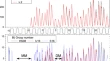
trends have been sought in these datasets. Panel D of Figure 19
and Panel E of Figure 19
present two such classical trends. The “Waldmeier Rule”, illustrated in Panel D of Figure 19
,
refers to a statistically significant anticorrelation between cycle amplitude and rise time (linear
correlation coefficient
). A similar anticorrelation exists between cycle amplitude and
duration, but is statistically more dubious (
). The “Gnevyshev-Ohl” rule, illustrated in
Panel E of Figure 19
, refers to a marked tendency for odd (even) numbered cycles to have
amplitudes above (below) their running mean (blue line in Panel E of Figure 19
), a pattern
that seems to have held true without interruption between cycles 9 and 21 (see also Mursula
et al., 2001
).
A number of long-timescale modulations have also been extracted from these data, most notably the
so-called Gleissberg cycle (period
), but the length of the sunspot number record is insufficient to
firmly establish the reality of these periodicities. One must bring into the picture additional solar cycle
proxies, primarily cosmogenic radioisotopes, but difficulties in establishing absolute amplitudes of
production rates introduce additional uncertainties into what is already a complex endeavour (for more on
these matters, see Beer, 2000; Usoskin and Mursula, 2003
). Likewise, the search for chaotic modulation in
the sunspot number time series has produced a massive literature (see, e.g., Feynman and
Gabriel, 1990; Mundt et al., 1991; Carbonell et al., 1994; Rozelot, 1995, and references therein), but
without really yielding firm, statistically convincing conclusions, again due to the insufficient lengths of the
datasets.
The aim in this section is to examine in some detail the types of fluctuations that can be produced in the various dynamo models discussed in the preceding section10. After going briefly over the potential consequences of fossil fields (Section 5.2), dynamical nonlinearities are first considered (Section 5.3), followed by time-delay effects (Section 5.4). We then turn to stochastic forcing (Section 5.5), which leads naturally to the issue of intermittency (Section 5.6).
| http://www.livingreviews.org/lrsp-2005-2 |
© Max Planck Society and the author(s)
Problems/comments to |