The
-quenching expression (24
) used in the preceding section amounts to saying that dynamo action
saturates once the mean, dynamo-generated field reaches an energy density comparable to that of
the driving turbulent fluid motions, i.e.,
, where
is the turbulent velocity
amplitude. This appears eminently sensible, since from that point on a toroidal fieldline would
have sufficient tension to resist deformation by cyclonic turbulence, and so could no longer
feed the
-effect. At the base of the solar convective envelope, one finds
, for
, according to standard mixing length theory of convection. However, various
calculations and numerical simulations have indicated that long before the mean field
reaches this strength, the helical turbulence reaches equipartition with the small-scale, turbulent
component of the magnetic field (e.g., Cattaneo and Hughes, 1996
, and references therein). Such
calculations also indicate that the ratio between the small-scale and mean magnetic components
should itself scale as
, where
is a magnetic Reynolds number based on
the microscopic magnetic diffusivity. This then leads to the alternate quenching expression
A way out of this difficulty was proposed by Parker (1993), in the form of interface dynamos. The idea
is beautifully simple: If the toroidal field quenches the
-effect, amplify and store the toroidal field away
from where the
-effect is operating! Parker showed that in a situation where a radial shear and
-effect are segregated on either side of a discontinuity in magnetic diffusivity (taken to coincide with the
core-envelope interface, see Panel A of Figure 9
), the
dynamo equations support solutions
in the form of travelling surface waves localized on the discontinuity in diffusivity. The key
aspect of Parker’s solution is that for supercritical dynamo waves, the ratio of peak toroidal field
strength on either side of the discontinuity surface is found to scale with the diffusivity ratio as
The next obvious step is to construct an interface dynamo in spherical geometry, using a solar-like
differential rotation profile. This was undertaken by Charbonneau and MacGregor (1997
). Unfortunately,
the numerical technique used to handle the discontinuous variation in
at the core-envelope
interface turned out to be physically erroneous for the vector potential
describing the poloidal
field8
(see Markiel and Thomas, 1999
, for a discussion of this point), which led to spurious dynamo action in
some parameter regimes. The matching problem is best avoided by using a continuous but rapidly varying
diffusivity profile at the core-envelope interface, with the
-effect concentrated at the base of the
envelope, and the radial shear immediately below, but without significant overlap between these two source
regions (see Panel B of Figure 10
). Such numerical models can be constructed as a variation on the
models considered earlier, and stand somewhere between Parker’s original picture (see Panel A of
Figure 9
) and the models with spatially localized
-effect and shear (see Panels B and C of
Figure 9
).
In conjunction with a solar-like differential rotation profile, making a working interface dynamo model is
markedly trickier than if only a radial shear is operating, as in the Cartesian models discussed earlier
(see Charbonneau and MacGregor, 1997; Markiel and Thomas, 1999
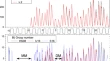
). Panel A of Figure 10
shows a
butterfly diagram for a numerical interface solution with
,
, and a
core-to-envelope diffusivity contrast
. A magnetic energy time series for this solution is plotted
in Panel D of Figure 8
, together with a solution with a smaller diffusivity contrast
(see
Panel C of Figure 8
). The poleward propagating equatorial branch is precisely what one would expect from
the combination of positive radial shear and positive
-effect according to the Parker-Yoshimura sign
rule9.
Here the
-effect is (artificially) concentrated towards the equator, by imposing a latitudinal dependency
for
, and zero otherwise.
|
Zhang et al. (2003a
) have presented results for a fully three-dimensional
interface dynamo model
where, however, dynamo solutions remain largely axisymmetric when a strong shear is present in the
tachocline. They use an
-effect spanning the whole convective envelope radially, but concentrated
latitudinally near the equator, a core-to-envelope magnetic diffusivity contrast
, and the usual
algebraic
-quenching formula. Unfortunately, their differential rotation profile is non-solar. However,
they do find that the dynamo solutions they obtain are robust with respect to small changes in the model
parameters. The next obvious step here is to repeat the calculations with a solar-like differential rotation
profile.
So far the great success of interface dynamos remains their ability to evade
-quenching even in its
“strong” formulation, and so produce equipartition or perhaps even super-equipartition mean toroidal
magnetic fields immediately beneath the core-envelope interface. They represent the only variety of
dynamo models formally based on mean-field electrodynamics that can achieve this without
additional physical effects introduced into the model. All of the uncertainties regarding the
calculations of the
-effect and magnetic diffusivity carry over from
to interface models, with
diffusivity quenching becoming a particularly sensitive issue in the latter class of models (see,
e.g., Tobias, 1996a).
Interface dynamos suffer acutely from something that is sometimes termed “structural fragility”. Many
gross aspects of the model’s dynamo behavior often end up depending sensitively on what one would
normally hope to be minor details of the model’s formulation. For example, the interface solutions of
Figure 10
are found to behave very differently if either
Compare also the behavior of the
solutions discussed here to those discussed in Markiel and
Thomas (1999). Once again the culprit is the latitudinal shear. Each of these minor variations on the
same basic model has the effect that a parallel mid-latitude dynamo mode, powered by the
latitudinal shear within the tachocline and envelope, interferes with and/or overpowers the
interface mode. This interpretation is not inconsistent with the robustness claimed by Zhang
et al. (2003a
), since these authors have chosen to omit the latitudinal shear throughout the
convective envelope in their model. Because of this structural sensitivity, interface dynamo
solutions also end up being annoyingly sensitive to choice of time-step size, spatial resolution,
and other purely numerical details. From a modelling point of view, interface dynamos lack
robustness.
| http://www.livingreviews.org/lrsp-2005-2 |
© Max Planck Society and the author(s)
Problems/comments to |