Mean-field electrodynamics is a subject well worth its own full-length review, so the foregoing discussion will be limited to the bare essentials. Detailed discussion of the topic can be found in Krause and Rädler (1980); Moffatt (1978), and in the recent review article by Hoyng (2003).
The task at hand is to calculate the components of the
and
tensor in terms of the statistical
properties of the underlying turbulence. A particularly simple case is that of homogeneous, weakly isotropic
turbulence, which reduces the
and
tensor to simple scalars, so that the mean electromotive force
becomes
The cyclonic character of the
-effect also indicates that it is equatorially antisymmetric and positive
in the Northern solar hemisphere, except perhaps at the base of the convective envelope, where the rapid
variation of the turbulent velocity with depth can lead to sign change. These expectations have
been confirmed in a general sense by theory and numerical simulations (see, e.g., Rüdiger and
Kitchatinov, 1993; Brandenburg et al., 1990; Ossendrijver et al., 2001
).
Leaving the kinematic regime, it is expected that both
and
should depend on the strength of
the magnetic field, since magnetic tension will resist deformation by the small-scale turbulent fluid motions.
The groundbreaking numerical MHD simulations of Pouquet et al. (1976
) suggested that Equation (21
)
should be replaced by something like
Adding this contribution to the MHD induction equation leads to the following form for the axisymmetric mean-field dynamo equations:
where, in general,
With the large-scale flows, turbulent diffusivity and
-effect considered given, Equations (25
, 26
)
become truly linear in
and
. It becomes possible to seek eigensolutions in the form
Clearly exponential growth of the dynamo-generated magnetic field must cease at some point, once the
field starts to backreact on the flow through the Lorentz force. This is the general idea embodied in
-quenching. If
-quenching - or some other nonlinearity - is included, then the dynamo equations are
usually solved as an initial-value problem, with some arbitrary low-amplitude seed field used as initial
condition. Equations (25
, 26
) are then integrated forward in time using some appropriate time-stepping
scheme. A useful quantity to monitor in order to ascertain saturation is the magnetic energy within the
computational domain:
One of the most remarkable property of the (linear)
dynamo equations is that they support travelling
wave solutions. This was first demonstrated in Cartesian geometry by Parker (1955), who proposed that a
latitudinally-travelling “dynamo wave” was at the origin of the observed equatorward drift of
sunspot emergences in the course of the cycle. This finding was subsequently shown to hold in
spherical geometry, as well as for non-linear models (Yoshimura, 1975; Stix, 1976). Dynamo
waves6
travel in a direction
given by
We first consider
models without meridional circulation (
in Equations (25
, 26
)), with the
-term omitted in Equation (26
), and using the diffusivity profile and angular velocity profile of
Figure 5
. We will investigate the behavior of
models with the
-effect operating throughout the
bulk of the convective envelope (red line in Figure 6
), as well as with an
-effect concentrated just above
the core-envelope interface (green line in Figure 6
). We also consider two latitudinal dependencies,
namely
, which is the “minimal” possible latitudinal dependency compatible with the
required equatorial antisymmetry of the Coriolis force, and an
-effect concentrated towards the
equator7
via an assumed latitudinal dependency
.
|
|
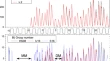
It is noteworthy that co-existing dynamo branches, as in Panel B of Figure 7
, can have distinct dynamo
periods, which in nonlinearly saturated solutions leads to long-term amplitude modulation. This is typically
not expected in dynamo models where the only nonlinearity present is a simple algebraic quenching
formula such as Equation (24
). A portion of the magnetic energy time-series for that solution is
shown in Panel A of Figure 8
to illustrate the effect. Note that this does not occur for the
solution (Panel B of Figure 8
), where both branches propagate away from each other,
but share a common latitude of origin and so are phased-locked at the onset (cf. Panel D of
Figure 7
).
|
Vector magnetograms of sunspots active regions make it possible to estimate the current helicity
which is closely related to the usual magnetic helicity
, and the amount of twist in the
sunspot-forming toroidal flux ropes (see, e.g., Hagyard and Pevtsov, 1999, and references therein). Upon
assuming that this current helicity reflects that of the diffuse, dynamo-generated magnetic field from which
the flux ropes formed, one obtains another useful constraint on dynamo models. In the context of classical
mean-field models, predominantly negative current helicity in the N-hemisphere, in agreement
with observations, is usually obtained for models with negative
-effect relying primarily
on positive radial shear at the equator (see Gilman and Charbonneau, 1999, and discussion
therein).
The models discussed above are based on rather minimalistics and partly ad hoc assumptions on the
form of the
-effect. More elaborate models have been proposed, relying on calculations of the full
-tensor based on some underlying turbulence models. While this approach usually displaces
the ad hoc assumptions away from the
-effect and into the turbulence model, it has the
definite advantage of offering an internally consistent approach to the calculation of turbulent
diffusivities and large-scale flows. Rüdiger and Brandenburg (1995) remain a good example
of the current state-of-the-art in this area; see also Rüdiger and Arlt (2003), and references
therein.
From a practical point of view, the outstanding success of the mean-field
model remains its robust
explanation of the observed equatorward drift of toroidal field-tracing sunspots in the course of the cycle in
terms of a dynamo-wave. On the theoretical front, the model is also buttressed by mean-field
electrodynamics which, in principle, offers a physically sound theory from which to compute the (critical)
-effect and magnetic diffusivity. The models’ primary uncertainties turn out to lie at that level, in that
the application of the theory to the Sun in a tractable manner requires additional assumptions that are
most certainly not met under solar interior conditions. Those uncertainties are exponentiated when
taking the theory into the nonlinear regime, to calculate the dependence of the
-effect and
diffusivity on the magnetic field strength. This latter problem remains very much open at this
writing.
| http://www.livingreviews.org/lrsp-2005-2 |
© Max Planck Society and the author(s)
Problems/comments to |