The meridional circulation in the solar envelope is much weaker than the differential rotation, making it
relatively difficult to measure (e.g., Hathaway, 1996a
). Furthermore, although it can in principle be probed
using global helioseismology (Woodard, 2000), the effect of meridional circulation on global
acoustic oscillations is small and may be difficult to distinguish from rotational and magnetic
effects (Giles et al., 1997
). Thus, we must currently rely on surface measurements and local
helioseismology.
Early attempts to measure the mean meridional circulation in the solar photosphere by both Doppler
and tracer techniques (reviewed by Hathaway, 1996a
; Snodgrass and Dailey, 1996
; Latushko, 1996
)
varied dramatically. Many suggested a poleward flow of
, but others found amplitudes
ranging from
and complex latitudinal structure with both poleward and equatorward flows,
multiple cells, and large asymmetries about the equator.
|
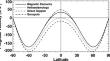
Recent estimates of the meridional circulation obtained from the cross-correlation of magnetic features
yield an average latitudinal flow which is poleward at low latitudes and weakly equatorward at high
latitudes, with a peak amplitude of about
(Komm et al., 1993
; Snodgrass and
Dailey, 1996
; Latushko, 1996
). However, these methods too exhibit large temporal variations. In the
26-year interval studied by Snodgrass and Dailey (1996
), the meridional flow achieves amplitudes
as large as
and often becomes equatorward at latitudes below
and above
.
Local helioseismology provides an alternative to surface measurements and gives us the capability of
probing the meridional flow below the photosphere. Near the surface the results are generally consistent
with Doppler and tracer measurements, showing poleward flow of about
with substantial time
variation and significant asymmetry about the equator (Giles et al., 1997
; Chou and Dai, 2001
; Haber
et al., 2002
; Basu and Antia, 2003
; Zhao and Kosovichev, 2004
).
Below the surface, Haber et al. (2002
) have reported a flow reversal in the northern hemisphere where
the circulation becomes equatorward at depths greater than about 3 Mm below the photosphere
(
), down to the limit of their sampling domain which lies at a depth of
(panel b in
Figure 2
). Their ring-diagram analysis spans six years, from
, with the flow reversal occurring
in the latter four, from
. Such a flow reversal is not evident in the time-distance results of Zhao
and Kosovichev (2004
) who present meridional flows averaged over depths of
and
. Several local helioseismic studies have attempted to probe deeper still. Giles et al. (1997)
presented time-distance results for the upper
of the solar interior and concluded that the
meridional flow throughout this region was poleward. Braun and Fan (1998) similarly find no
evidence for a return equatorward flow down to
. Inferring the circulation at depth
below about
is a difficult task and it is still too early to know what to make of these
efforts.
There is evidence from both surface measurements and local helioseismology that the amplitude of the
meridional circulation may be anticorrelated with magnetic activity, decreasing during solar maximum and
increasing during solar minimum (Komm et al., 1993
; Chou and Dai, 2001; Basu and Antia, 2003).
Furthermore, a weak meridional circulation component of a few
has been found which diverges out
of magnetic activity belts and propagates with them toward the equator as the activity cycle progresses
(Snodgrass and Dailey, 1996
; Beck et al., 2002
). However, Zhao and Kosovichev (2004
) report the
opposite: weak meridional flows which converge toward activity belts. They argue that the convergence
occurs in the outermost layers, less than
below the photosphere whereas the divergence occurs
deeper down.
Although much progress has been made in recent years, improving our understanding of the meridional circulation throughout the convective envelope remains an important challenge for local helioseismology in particular and will be a major research focus in the near future.
| http://www.livingreviews.org/lrsp-2005-1 |
© Max Planck Society and the author(s)
Problems/comments to |