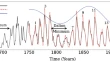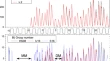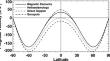
The most well-established temporal variations in the solar differential rotation are torsional oscillations,
which have been studied using global helioseismology, local helioseismology, and surface Doppler
measurements (Howard and LaBonte, 1980; Ulrich et al., 1988
; Howe et al., 2000b; Vorontsov
et al., 2002
; Haber et al., 2002
; Basu and Antia, 2003
; Zhao and Kosovichev, 2004
). These are
alternating bands of faster and slower rotation which propagate with a cyclical period of 11
years. At latitudes below about 42
, the bands propagate equatorward but at higher latitudes
they propagate poleward. The low-latitude bands are about
wide in latitude and extend
from the surface down to
or deeper, possibly to the base of the convection zone.
The high-latitude bands are somewhat wider and deeper, possibly extending to the base of the
convection zone (Vorontsov et al., 2002
). The amplitude of the angular velocity variation is about
, which is roughly 1% of the mean rotation rate. This corresponds to a zonal flow of about
.
The 11-year period of the torsional oscillations strongly suggests that they are associated in some way
with the 22-year solar activity cycle. Indeed, surface magnetic activity correlates well with the
oscillation patterns, with activity belts tending to lie on the poleward side of the faster-rotating
bands at low latitudes, migrating toward the equator together as the activity cycle progresses
(Zhao and Kosovichev, 2004
). Recent results by Beck et al. (2002
) based on time-distance
helioseismology indicate that meridional flows may be diverging out of the activity belts, with
equatorward and poleward flows correlating well with the faster and slower bands of the torsional
oscillations, respectively. There is some evidence that the zonal bands may get slightly faster at times
of peak magnetic activity (Zhao and Kosovichev, 2004
). Some evidence has also been found
for higher-order harmonics in the torsional oscillation signal (Vorontsov et al., 2002) and for
possibly related non-axisymmetric wave patterns having longitudinal wavenumbers up to
(Ulrich, 2001
).
The second type of oscillation which has been detected in the differential rotation profile, first reported
by Howe et al. (2000a
), is distinct from the torsional oscillation in that it has a shorter period,
and it is localized around the tachocline and the lower convection zone. Furthermore, there is currently no
evidence for latitudinal propagation. Rather, it appears to be a standing wave straddling the
base of the convection zone, with angular velocity variations at
out of phase
with those at
. The amplitude of the angular velocity variation is about 3 nHz
at the equator and perhaps slightly larger,
, at a latitude of 60
. The oscillation
may not be strictly periodic; the high-latitude signal in particular appears to be somewhat
erratic.
The tachocline oscillation signal is not far from the current sensitivity limits of helioseismic inversions so
it is difficult to probe in detail. Basu and Antia (2001
) find roughly periodic variations similar to those
reported by Howe et al. (2000a) but they argue that the result is not statistically significant. A subsequent
analysis by Toomre et al. (2003) further made the case that the oscillations are indeed real but they appear
to be varying in amplitude as the solar cycle proceeds, first waning then waxing. Further monitoring
of these oscillations is needed in order to verify their presence and better understand their
origin.
In addition to the torsional and tachocline oscillation patterns, the solar rotation, particularly at high
latitudes, undergoes monthly variations on the order of a few percent or less which appear to be more
random (Toomre et al., 2000). Apart from these small variations, the differential rotation profile
appears to be remarkably steady. Surface measurements show little variation for well over a
century (Gilman, 1974; Schröter, 1985; Rüdiger, 1989
). Still, there is some indication that the
low-latitude rotation rate as traced by sunspots may increase by as much as a few percent during
periods of minimum and to a lesser extent maximum activity (Howard, 1984; Hathaway and
Wilson, 1990; Javaraiah, 2003
). Longer-term variations may also be present. Javaraiah (2003) has
considered rotation data from sunspot groups covering the period from
and has found
possible evidence for several patterns, including a speedup of the equatorial rotation rate by
in alternate sunspot cycles, accompanyed by an increase in the differential rotation
(latitudinal angular velocity gradient) and a greater asymmetry between the northern and southern
hemispheres.
Sunspot groups may not be accurate tracers of solar rotation. Small variations in their rotational properties may reflect other physics, such as where they are “anchored” to the plasma. Thus, we are only beginning to explore systematic variations in the solar rotation over time scales of years and decades. High-quality helioseismic inversions have only been available for a single sunspot cycle. Continued monitoring of the internal rotation profile via helioseismology promises to provide new insight into its evolution for many years to come.
| http://www.livingreviews.org/lrsp-2005-1 |
© Max Planck Society and the author(s)
Problems/comments to |