Recent helioseismic estimates by Charbonneau et al. (1999a
) and Basu and Antia (2003
)
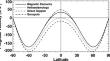
indicate that the tachocline is centered at
near the equator. This is
below the convection zone base of
but it may lie within the overshoot
region (Section 3.6). At higher latitudes, the location of the tachocline shifts upward, reaching
at a latitude of 60
(Charbonneau et al., 1999a
; Basu and Antia, 2003
). Thus,
the tachocline is significantly prolate. This is in contrast to the base of the convection zone,
, in which helioseismic inversions have not yet detected any significant latitudinal variation
(Section 3.6).
Estimates of the width of the tachocline vary according to how it is defined. Charbonneau et al. (1999a
)
characterize the transition in terms of an error function
These helioseismic results suggest that the tachocline lies almost entirely below the convective envelope
at low latitudes but it may extend well into the convection zone at high latitudes. Moreover, it appears that
the tachocline contains the overshoot region but extends beyond it, perhaps both above and below.
However, these results may need to be reexamined in light of new determinations of elemental abundances
in the solar envelope, which has important implications for helioseismic inversions (Asplund
et al., 2005
; Bahcall et al., 2005
).
Throughout most of the tachocline, the vertical shear in the mean zonal velocity almost
an order of magnitude larger than the latitudinal shear:
whereas
. The exception is at latitudes of
35
where
changes sign. The
total change in the zonal velocity across the tachocline is about
at the equator and somewhat
less at high latitudes,
.
| http://www.livingreviews.org/lrsp-2005-1 |
© Max Planck Society and the author(s)
Problems/comments to |