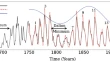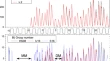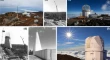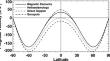
Plasma flows in the photosphere may be measured directly by Doppler imaging or may be inferred by tracking the horizontal movement of magnetic structures, emission features, and convective patterns across the solar disk. Such measurements provide a useful check on near-surface flow fields obtained from helioseismology. Surface measurements also provide an extensive time history of the solar rotation profile, tracing its long-term evolution. The differential rotation of the solar surface has been monitored for almost 150 years (since Carrington, 1863) and careful analysis of prior sunspot records can potentially extend this time coverage even further back (Eddy et al., 1977; Ribes and Nesme-Ribes, 1993). By comparison, helioseismic determinations of the solar rotation only date back to the mid 1980’s.
Doppler maps of photospheric flow fields, known as Dopplergrams, are dominated by granulation:
small-scale (
) turbulent convection cells confined to the near-surface layers and driven by
ionization and radiative transfer effects. Characteristic velocity amplitudes depend somewhat on the
resolution of the instrument but are, at least, several
. More sophisticated analyses, such as
correlation tracking, also reveal another scale of convection known as supergranulation with characteristic
length and velocity scales of about
and several hundred
(Leighton et al., 1962; DeRosa
and Toomre, 2004). At intermediate scales of
, another pattern known as mesogranulation has
also been detected in correlation tracking measurements with characteristic velocity amplitudes of
(November et al., 1981; Muller et al., 1992). However, mesogranulation is not apparent in
power spectra computed from Doppler measurements of surface velocities whereas granulation and
supergranulation are (Hathaway, 1996b
; Hathaway et al., 2000
). Such patterns must be filtered out or
otherwise removed from surface Doppler measurements in order to detect the relatively weak,
larger-scale motions more relevant to the dynamics of the deep solar interior, including differential
rotation (
), meridional circulation (
), and larger-scale convective
motions (
). The five-minute acoustic oscillations which form the basis of
helioseismology must also be filtered out when studying large-scale surface flows by means of Doppler
measurements.
Removing contaminating signals arising from rotation, granulation, supergranulation, acoustic oscillations, and small-scale magnetic activity is perhaps the biggest challenge in determining large-scale flow patterns from surface Doppler measurements. Projection effects such as limb darkening also pose problems for both Doppler and tracking techniques, and the non-uniform rotation of the Sun makes it more difficult to identify and monitor long-lived velocity features. Furthermore, techniques which rely on tracking magnetic features or flow patterns via auto-correlations can give misleading results if the features or patterns evolve substantially over the course of the tracking interval or if the features are not just passively advected by the fluid as is implicitly assumed.
Measurements of photospheric intensity or irradiance are also very instructive from the standpoint of
solar interior dynamics because they may reflect inhomogeneities in temperature or heat flux
induced by large-scale convective motions. However, detecting such large-scale variations is
difficult because, like Doppler measurements, solar irradiance measurements are dominated by
granulation patterns and small-scale emission features related to magnetic activity such as faculae.
After removing these effects, the residual latitudinal variations are only about one part in 10
(Section 3.7).
The Sun exhibits a wide variety of magnetic activity, from the quiet photospheric network to sunspots
and coronal loops to MHD waves and explosive events such as flares and coronal mass ejections. Indeed,
solar magnetism lies at the heart of nearly all the companion reviews in this journal, including
Charbonneau (2005
); Fan (2004
). Although much of this research focuses on structures in the solar
atmosphere, the ultimate origin of this magnetic activity lies below the surface, in the convection zone and
tachocline (Section 4.5). Reproducing patterns of magnetic activity such as the solar butterfly diagram
(Section 3.8) therefore ranks among the most important and difficult challenges to dynamical models of the
solar interior.
| http://www.livingreviews.org/lrsp-2005-1 |
© Max Planck Society and the author(s)
Problems/comments to |