This section is not intended as a comprehensive review. For much more discussion of mean-field
hydrodynamics see Rüdiger (1989
), Canuto and Christensen-Dalsgaard (1998), and Rüdiger and
Hollerbach (2004
). For a review of mean-field dynamo models see Ossendrijver (2003
), Rüdiger and
Hollerbach (2004
), and Charbonneau (2005
).
In mean-field hydrodynamics, the components of the Reynolds stress which transfer angular momentum are
typically represented in terms of a diffusive contribution represented by an anisotropic turbulent
viscosity
and a non-diffusive contribution known as the
-effect [Equation (23
)]. These two
contributions are generally comparable in amplitude so the relative strength of the Coriolis
force and the Reynolds stress may be quantified by the Taylor number based on the turbulent
viscosity:
. This is in effect the inverse square of the Rossby number defined in
Equation (9
).
Many early mean-field models of the solar internal rotation relied only on Reynolds stress
parameterizations, with the meridional circulation specified or neglected altogether. An example is the
model of Küker et al. (1993) who obtained solar-like rotation profiles using the
-effect
theory of Kitchatinov and Rüdiger (1993
). However, their solutions were inconsistent with the
thermal wind balance Equation (11
) because they did not take into account the Coriolis-induced
circulations which would be driven by the rotation profiles they achieved. At the large Taylor
numbers required by their model, Equation (11
) implies cylindrical rotation profiles in the
absence of baroclinic effects. Other estimates for the amplitude of the turbulent viscosity have
similar implications (Rüdiger, 1989; Durney, 1999
; Rüdiger and Hollerbach, 2004
). This is
the “Taylor number puzzle” discussed by Kitchatinov and Rüdiger (1995
) and Rüdiger and
Hollerbach (2004
).
As in global convection simulations, cylindrical rotation profiles can be avoided in two ways,
either the Reynolds stress must be substantial (implying smaller Taylor numbers) or latitudinal
entropy gradients must be established which maintain a thermal wind differential rotation. Most
mean-field models now rely on the latter to achieve solar-like rotation profiles (Kitchatinov and
Rüdiger, 1995; Durney, 1999; Küker and Stix, 2001
; Rüdiger and Hollerbach, 2004
; Rempel, 2005
).
These models are typically based on anisotropic parameterizations for the convective heat flux obtained
from mixing-length theory, modified to account for the influence of rotation. An exception is the
mean-field model developed by Rempel (2005
) in which the required entropy perturbations
originate from thermal wind balance in the tachocline and spread upward into the convection zone
without the need for an anisotropic parameterization of the thermal diffusivity (this model is
discussed further in Section 7.3). In mean-field models which incorporate convective heat transport,
the meridional circulation is usually solved for together with the angular velocity and entropy
profiles.
The meridional circulation is generally more sensitive to the parameterizations than the
differential rotation (Küker and Stix, 2001
). This is again consistent with global simulations
where the meridional circulation is maintained by a delicate balance of forces (Section 6.4). For
moderate values of the mixing length parameter and for solar-like rotation rates, Küker and
Stix (2001
) find that the circulation has two cells in radius per hemisphere, with equatorward
circulation at the top and bottom of the convection zone and poleward circulation in between. The
equatorward surface flow is inconsistent with photospheric measurements and helioseismic inversions
(Section 3.4), but multiple-cell structure in depth is also exhibited by global convection simulations
(Section 6.4).
The equatorward surface circulation in the Küker and Stix (2001) model can be attributed to the
Reynolds stress parameterization. The Kitchatinov and Rüdiger (1993) theory of the
-effect yields an
outward angular momentum flux near the surface. If the meridional circulation is to balance this outward
Reynolds stress as expressed by Equation (8
) and if the angular velocity profile is to be solar-like, then the
circulation must be equatorward. Conversely, an inward angular momentum flux by the Reynolds stress
near the surface implies a poleward circulation. If the Reynolds stress parameterization exhibits inward
angular momentum transport near the surface, not only can it produce a poleward circulation as suggested
by observations, but it may also establish a subsurface increase in angular velocity analogous to the
near-surface shear layer found in helioseismic inversions (Section 3.1). This is indeed the case
for the mean-field model developed by (Rempel, 2005
). Rempel’s model provides important
insight into how the solar differential rotation may be maintained but there is currently little
physical justification for the Reynolds stress parameterizations which best match observational
data.
In global convection simulations, the angular momentum transport by Reynolds stresses is typically
outward as shown in Figure 14
, although it is nearly balanced by inward viscous diffusion. As higher
Reynolds numbers are achieved and the viscous diffusion is reduced, the Reynolds stress and meridional
circulation must adjust accordingly if they are to maintain a solar-like differential rotation as well as a
poleward surface circulation.
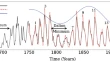
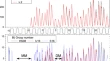
No review of solar interior dynamics would be complete without some mention of the thriving field of mean-field solar dynamo modeling. These models seek to reproduce observational manifestations of the solar activity cycle, including the butterfly diagram (Section 3.8), the propagation and phase relationship between axisymmetric poloidal and toroidal fields, and long-term or sporadic cycle variations such as the Maunder minimum. Solar dynamo models are generally quite successful in this regard and have provided much insight into the origin of cyclic magnetic activity on the Sun.
Despite this success, there is still much uncertainty with regard to the primary physical mechanisms
responsible for regenerating poloidal field from toroidal field (the
-effect) and with regard to the role (or
lack thereof) of the meridional circulation (Mestel, 1999
; Ossendrijver, 2003
; Charbonneau, 2005
).
Furthermore, the theoretical foundation of many solar dynamo models remains questionable. Global
simulations can be used to help validate mean-field theory although they do not yet possess the resolution
or physical conditions to explicitly capture many of the processes which are currently parameterized in
dynamo models. Examples include flux-tube instabilities in the tachocline and magnetic diffusion in the
solar surface layers due to the decay of active regions. The latter is a fundamental component of
Babcock-Leighton dynamo models Mestel (1999); Charbonneau (2005
). Global MHD simulations have not
yet achieved a shear layer at the bottom of the convection zone comparable to the solar tachocline so they
cannot currently be used to validate or motivate interface dynamo models in which the toroidal and
poloidal field generation occurs in spatially separated regions. However, this will soon change as global
convection simulations incorporate a tachocline either self-consistently or by imposed forcing
(Section 7.3).
Many of the approximations commonly used in mean-field dynamo theory are not justified
by global convection simulations. In particular, there is no clear scale separation in space or
time13
so there is no guarantee that series expansions such as that in Equation (22
) will converge
Ossendrijver (2003
). Furthermore, the amplitude of the fluctuating magnetic fields exceeds that of the mean
fields and the non-axisymmetric analogue of the turbulent emf
is not small relative to the
other terms in the fluctuating induction equation, calling into question the first-order smoothing
approximation which is implicit in most mean-field models (Moffatt, 1978; Ossendrijver, 2003
).
Although their justification formally breaks down, mean-field models may be still used to interpret some
aspects of global MHD convection simulations. The highest resolution achieved to date in such simulations
is represented by Case M3, discussed in Section 6.5. Here the toroidal field regeneration due to
differential rotation is comparable to that due to the turbulent emf. Thus, Case M3 might be
classified as an
-
dynamo in the terminology of mean-field theory. This might help to
explain its non-cyclic behavior. In mean-field theory,
-
dynamos are generally more
likely to yield cyclic, dipolar solutions than
or
-
dynamos (Charbonneau and
MacGregor, 2001; Rüdiger et al., 2003; Rüdiger and Hollerbach, 2004
) In the more laminar
MHD convection simulations by Gilman (1983) and Glatzmaier (1985a) differential rotation
plays a bigger role, the dynamo was more akin to
-
type, and cyclic, dipolar solutions
were found. Moreover, the poleward propagation of magnetic flux in these simulations over
the course of a cycle is consistent with the Parker-Yoshimura sign rule of mean-field theory
(Charbonneau, 2005
).
Numerical simulations of MHD convection can be used not only to evaluate mean-field models but also
to calibrate them by providing estimates for model parameters such as
and
. Furthermore,
simulations can provide important insight into nonlinear saturation mechanisms which are often
parameterized in mean-field models as quenching of
,
, and
. Such efforts have proliferated in
recent years (reviewed by Ossendrijver, 2003
; Brandenburg and Subramanian, 2004; Rüdiger and
Hollerbach, 2004), although most of this work has focused on Cartesian geometries. Further progress in this
area promises to improve our understanding of dynamo processes and to improve the reliability of solar and
stellar dynamo models.
| http://www.livingreviews.org/lrsp-2005-1 |
© Max Planck Society and the author(s)
Problems/comments to |