The most extreme form of the thin-shell limit is to neglect vertical motions, magnetic fields, and gradients entirely, leaving the 2D equations of magnetohydrodynamics (MHD) in latitude and longitude. Such models have recently been used to investigate linear MHD shear instabilities in the tachocline and their subsequent nonlinear evolution (see Section 8.2).
Some degree of vertical variation can be taken into account without greatly increasing the mathematical
complexity of the problem by treating the upper boundary of the layer as a free surface. In this case one can
apply the so-called shallow-water (SW) equations which are commonly used in meteorology and
oceanography (e.g., Pedlosky, 1987
). Gilman (2000b) has generalized the SW system to include magnetic
fields in order to model the stably-stratified portion of the solar tachocline. The upper boundary of this
layer is the solar convection zone which is nearly adiabatically-stratified and which therefore should offer
little buoyant resistance to surface deformations. This is the rationale behind the SW approach in a
tachocline context.
In the SW approximation, motions are assumed to be incompressible and the vertical momentum
equation reduces to magneto-hydrostatic balance. Horizontal velocities and magnetic fields are assumed to
be independent of height
but unlike the 2D approach, they can possess a horizontal divergence which
gives rise to vertical flows and fields. Vertical motions do not overturn; rather, they deform the outer
surface. Integrating the magneto-hydrostatic equation over depth gives a direct relationship between
the total pressure (gas plus magnetic) and the height of the layer. Thus, the complete SW
system consists of the 2D horizontal momentum and induction equations together with another
evolution equation for the layer height and divergence-free conditions for the velocity and magnetic
fields.
The MHD SW equations conserve energy, mass, momentum, magnetic flux, and other quantities known
as Casimir functionals (Dellar, 2002). They also support a variety of wave modes including Alfvén waves
and MHD analogues of surface gravity waves (Schecter et al., 2001). Dikpati and Gilman (2001b
) have
used the shallow water system to investigate dynamical equilibria in the solar tachocline between pressure
gradients and the magnetic tension force associated with an axisymmetric ring of toroidal flux.
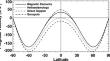
The poleward tension force is balanced by an equatorward pressure gradient supplied by a
buildup of mass at the poles, yielding a prolate tachocline structure as suggested by helioseismic
inversions (Section 3.2). Rempel and Dikpati (2003) showed that the required prolateness is
reduced if the flux ring contains a zonal jet which helps balance the magnetic tension through
the Coriolis force. They also showed that the SW treatment of this problem is analogous to
one based on the axisymmetric MHD equations in which the latitudinal pressure gradients are
supplied by deformations of the isentropic surfaces. The MHD SW equations have also been used
to investigate the linear stability of the latitudinal differential rotation in the tachocline (see
Section 8.2).
Another approach which has its roots in meteorology and oceanography is to explicitly take the
thin-shell limit of the governing equations in a stably-stratified fluid layer, retaining the full
height dependence of all flows and fields. This yields what geophysicists call the hydrostatic
primitive equations (HPE) which have formed the basis of climate and ocean models for decades
(e.g., Pedlosky, 1987
; Salby, 1996). An MHD generalization of the HPE system has recently been
developed by Miesch and Gilman (2004). This thin-shell system preserves the conservation
properties of the full 3D MHD equations (energy, mass, momentum, magnetic helicity) and is
dynamically rich enough to incorporate vertical shear, internal gravity waves, and stratified
MHD turbulence. Yet, it is more computationally efficient and analytically accessible than
the full 3D equations. For example, separation of variables in the thin-shell system has been
exploited to obtain analytic results on the penetration of meridional circulation below the solar
convection zone (Gilman and Miesch, 2004
) and MHD shear instabilities in the tachocline (see
Section 8.2).
A limitation of both the SW and the thin-shell systems is that they do not incorporate magnetic buoyancy which requires a complete vertical momentum equation. Other approximations which have been used to simplify the equations of motion in the tachocline and radiative interior include geostrophic balance and axisymmetry. Some of these approaches will be discussed in Section 8.
| http://www.livingreviews.org/lrsp-2005-1 |
© Max Planck Society and the author(s)
Problems/comments to |