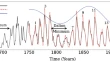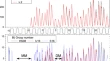
The most familiar and compelling magnetic activity pattern in the Sun is the sunspot cycle and the
corresponding butterfly diagram (e.g., Stix, 2002
). Sunspots and other manifestations of magnetic activity
emerge in well-defined latitudinal bands which migrate toward the equator on a timescale of about 11 years.
As these activity bands converge on the equator, the polarity of the global field reverses and the emergence
pattern repeats, returning to its previous magnetic configuration after two reversals, yielding a net 22-year
periodicity.
Sunspot groups are often separated into regions of outward and inward magnetic polarity which are
aligned nearly east-west (meaning the neutral line is nearly north-south), but tilted somewhat
relative to lines of constant longitude. The polarity of the leading (eastern) side is opposite
in each hemisphere and reverses sign every 11 years with the activity cycle (known as Hale’s
polarity rules) whereas the tilt angle increases approximately linearly with latitude (known as
Joy’s law). These patterns suggest that bipolar active regions are made up of toroidal magnetic
flux which has emerged as a loop from below the photosphere and may still be anchored there
(Fan, 2004
).
|
Another pattern in magnetic activity which has particular relevance to solar interior dynamics is the presence of active nests or active longitudes: localized regions of the solar photosphere where magnetic flux appears to emerge preferentially and repeatedly over the course of multiple rotation periods (Bumba and Howard, 1965; Bogart, 1982; Brouwer and Zwaan, 1990). DeToma et al. (2000) chart a number of such regions during the rising phase of the current solar cycle. They find nests which persist for up to seven rotations, and the number of simultaneous nests increases progressively as the cycle proceeds from zero in late 1995 to three in 1998 (previous studies revealed up to six coexisting longitudinal bands of enhanced activity).
The global structure of the coronal magnetic field as inferred from white light observations can also
provide insight into the nature of the solar dynamo operating in the interior, although it is
strongly influenced by dynamical processes in the atmosphere as well, such as advection by
the solar wind (Aschwanden et al., 2001
). Potential-field extrapolations from photospheric
measurements and more sophisticated coronal models yield a complex web of magnetic loops and open
fields with a range of size scales and connectivity across the solar surface (e.g., Altschuler and
Newkirk, 1969; Gibson et al., 1999
; Aschwanden et al., 2001
; Schrijver and DeRosa, 2003). On the
largest scales, the axisymmetric component of the poloidal field is approximately dipolar during
solar minimum with an amplitude at the solar photosphere of roughly 10 G. However, as the
activity cycle progresses, the field becomes much more complicated and dynamic, with substantial
contributions from higher-order multipoles. Figure 4
illustrates the coronal field structure near solar
maximum. Note that a potential-field extrapolation as shown does not take into account dynamics
occurring above the photosphere and thus may not in general be an accurate indicator of the
actual field structure (Gibson et al., 1999; Aschwanden et al., 2001). However, it is a good first
approximation and suffices for our purposes here, as a diagnostic of dynamo processes in the solar
interior.
| http://www.livingreviews.org/lrsp-2005-1 |
© Max Planck Society and the author(s)
Problems/comments to |