Despite this seething complexity, the Sun exhibits some striking regularities. Among these is the
latitudinal variation of the surface rotation rate, which is non-uniform; equatorial regions rotate with a
period of about 27 days whereas polar regions rotate with a period of about 35 days. This differential
rotation pattern is remarkably smooth and steady, monotonically decreasing from equator to pole and
varying by not more than about 5% since the first systematic measurements were made by
Carrington (1863
) over a century ago. Another striking manifestation of order amid the chaos of solar
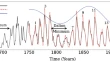
convection is the solar activity cycle in which belts of magnetic activity regularly appear at mid latitudes,
propagate toward the equator, and then vanish as new activity belts form at mid latitudes and repeat the
process (Schrijver and Zwaan, 2000
; Stix, 2002
; Charbonneau, 2005
). Other systematic patterns are also
evident within the framework of this activity cycle, such as the orientation and chirality of individual active
regions and the frequency and magnitude of eruptive events such as flares and coronal mass ejections (see
Section 3.8).
Turbulent, electrically conducting flows such as solar granulation are generally capable of amplifying and
maintaining magnetic fields through hydromagnetic dynamo action. This is the likely origin of much of the
small-scale magnetic flux observed in the photosphere, sometimes referred to as the magnetic carpet or as
the salt and pepper which dots high-resolution magnetograms of the solar disk (e.g., Schrijver and
Zwaan, 2000
). This small-scale flux concentrates in granular downflow lanes and evolves rapidly, continually
replenishing itself in less than a day. However, it does not exhibit the emergence patterns and cyclic
behavior characteristic of much larger active regions. Rather, the generation of small-scale magnetic flux
locally by dynamo action within the solar surface layers and its advection by granulation and
supergranulation is distinct from, but coupled to, the generation of larger-scale field which is manifested in
the solar activity cycle (Simon et al., 2001). Thus, there is not one solar dynamo, but two: a local
dynamo which continuously generates small-scale, relatively random magnetic fluctuations in
the solar surface layers, and a global dynamo which maintains the larger-scale cyclic activity
(Cattaneo, 1999
).
The regularities in magnetic activity associated with the global dynamo likely have little to do with the
granulation and supergranulation patterns observed in the photosphere. These motions are thought to be
confined to the upper few percent of the solar interior (
). Solar structure models and
helioseismic inversions suggest that the solar envelope is convectively unstable over a much larger region,
down to
(Christensen-Dalsgaard et al., 1991
; Basu and Antia, 2001
). Relative to granulation
and supergranulation, the motions which occupy the bulk of the solar convection zone are thought to be
larger-scale and slower, with turnover timescales comparable to the solar rotation period of about one
month. These motions are thus more influenced by rotation which induces anisotropic momentum and
heat transport, thus maintaining global-scale flows such as differential rotation and meridional
circulations. Such flows are thought to play a key role in the global dynamo. Rotation also
induces kinetic and magnetic helicity, another important ingredient in solar dynamo theory
(Section 4.5).
Understanding the dynamics and dynamo processes occurring within the deep solar convection zone has
far-reaching implications for understanding solar and stellar magnetism, evolution, structure, and
variability. Furthermore, since much of solar variability is tied to cyclic magnetic activity, such insight is
essential in order to gain a better understanding of how the Sun influences life on Earth through a variety of
processes collectively known as space weather (Schrijver and Zwaan, 2000
). However, large-scale convection
motions in the Sun are notoriously difficult to observe directly because they are masked by the much more
vigorous granulation in the near-surface layers (Section 3.5). We must instead rely on their indirect
observational manifestations such as magnetic activity in the solar atmosphere and the internal
rotation profile inferred from helioseismology (Section 3.1). The helioseismic investigations
have proven particularly enlightening as they have revealed a narrow layer of strong radial
shear in the solar angular velocity, where the differential rotation of the convective envelope
undergoes a transition to nearly uniform rotation in the radiative interior. The discovery of this
shear layer, now known as the solar tachocline, has had profound implications for solar dynamo
theory.
In this review we will give a general overview of solar interior dynamics, focusing on large-scale
motions in the convection zone and tachocline. Smaller-scale dynamics in the solar surface layers
including granulation, supergranulation, and issues relating to the local dynamo are discussed
elsewhere in this journal. Although we will often discuss the deep convection zone and tachocline in
the context of the global dynamo, we make no attempt to cover all aspects of solar dynamo
theory. More comprehensive discussions of solar dynamo modeling and of the evolution and
emergence of magnetic flux in the convection zone can be found in these volumes in the reviews by
Fan (2004
) and Charbonneau (2005
). Even with this restricted scope, the subject matter is
vast and we must necessarily focus on some aspects more than others. Particular emphasis
will be placed on 3D numerical simulations of turbulent convection. References are provided
throughout should the reader wish to explore the subject matter further or to seek a different
perspective.
This review is organized as a web-based reference in that it has a modular form and ample cross-referencing; the reader is encouraged to skip to the sections of most interest. Like most reviews, it is targeted mainly at non-specialists: students and interested researchers from other disciplines.
In Section 2 we describe the means by which we can potentially glean information about the solar interior; how do we know what we know? The most relevant observational results are then be reviewed in Section 3. There we discuss observational diagnostics of convection, mean flows, and dynamo processes in the solar envelope. We also define the tachocline and review what is known about it observationally. Some fundamental theoretical principles and modeling approaches are then discussed in Sections 4 and 5. Among these approaches, high-resolution numerical simulations of thermal convection in rotating spherical shells offer unique promise in elucidating the complex turbulent dynamics of the solar convection zone and we discuss their implications, current limitations, and future prospects in Sections 6 and 7. We then turn to the tachocline and the region of convective overshoot which forms the interface between the solar envelope and the radiative interior. Since most of the tachocline is thought to be stably-stratified, it exhibits qualitatively different dynamics relative to the convection zone, as we discuss in Section 8. We close with an attempt to tie it all together in Section 9 where we assess the current state of interplay between dynamical models and observations.
| http://www.livingreviews.org/lrsp-2005-1 |
© Max Planck Society and the author(s)
Problems/comments to |